The concept of borderlands is a popular topic in recent historical studies of modern European history. Over the past several decades, a growing number of scholars of European history have focused their attention on the borderlands of Europe, which were zones of great ethnic and cultural diversity. Often, these historians turned their attention to the borderlands of eastern Europe, the one-time “shatterzone of empires,” to borrow the title of a collection of articles about these borderlands edited by the prominent historians Omer Bartov and Eric D. Weitz. This “shatterzone” was the region where, until the early twentieth century, the Prussian (later German), Austrian, Russian, and Ottoman Empires came into direct contact with one another. It was also the site, especially after the First World War, of often-extreme violence and governmental projects designed to reduce (or eliminate altogether) the ethnic, cultural, linguistic, and religious diversity of this borderlands region.
While widely-read works that deal with the conflicts surrounding and violence committed in Europe’s eastern borderlands, such as Timothy Snyder’s Bloodlands: Europe Between Hitler and Stalin, often give the impression that the borderlands of eastern Europe are the only borderlands in Europe, there are borderlands throughout Europe: east and west, north and south. The German-German border – the boundary between East and West Germany from 1949 to 1990 – was a borderland, one that has been the subject of recent scholarly interest, particularly because of its character as an entirely man-made, imposed border: that is, one that did not follow some kind of preexisting geographic boundary or the course of an older political border. In western and southern Europe, there are many borderland regions, though they are less well-known as borderlands, partially because some of these areas are now contained within one country (and, thus, are no longer truly borderlands) and partially because, for a variety of reasons, these borderlands did not experience the same level of ethnic violence as Europe’s eastern borderlands did during the twentieth century.
So, if you are intrigued by the idea of borderlands and would like to visit a borderland in order to view the evidence of and experience the contemporary manifestations of the cultural, ethnic, linguistic, and religious diversity of these regions, where should you go? Because of the events of the twentieth century, which resulted in the wholesale destruction of many of Europe’s eastern borderland regions, my suggestions will focus on western and central Europe.
The inter-German border, while not a historical borderland (since it only existed for forty years and only came into existence between 1945 and 1949), was nevertheless a borderland, as several historians of modern Germany have highlighted in the past decade or so, producing works analyzing the “borderland” dimension of the boundary between East and West Germany. Since German reunification in 1990, most of the physical manifestations of the border (the guard towers, the fence, the death strips, etc.) have been removed, though there is still a great deal of environmental evidence of the border, which had a large impact on its surrounding biological environment. The most obvious place to view the remnants of the inter-German border is Berlin, since the Berlin Wall was one part of the larger border complex. The Gedenkstätte Berliner Mauer is an excellent place at which to learn more about the Berlin Wall: it preserves a section of the wall along Bernauer Strasse, as well as the grounds behind the wall, allowing visitors to see how the border fortifications developed and operated in Berlin.
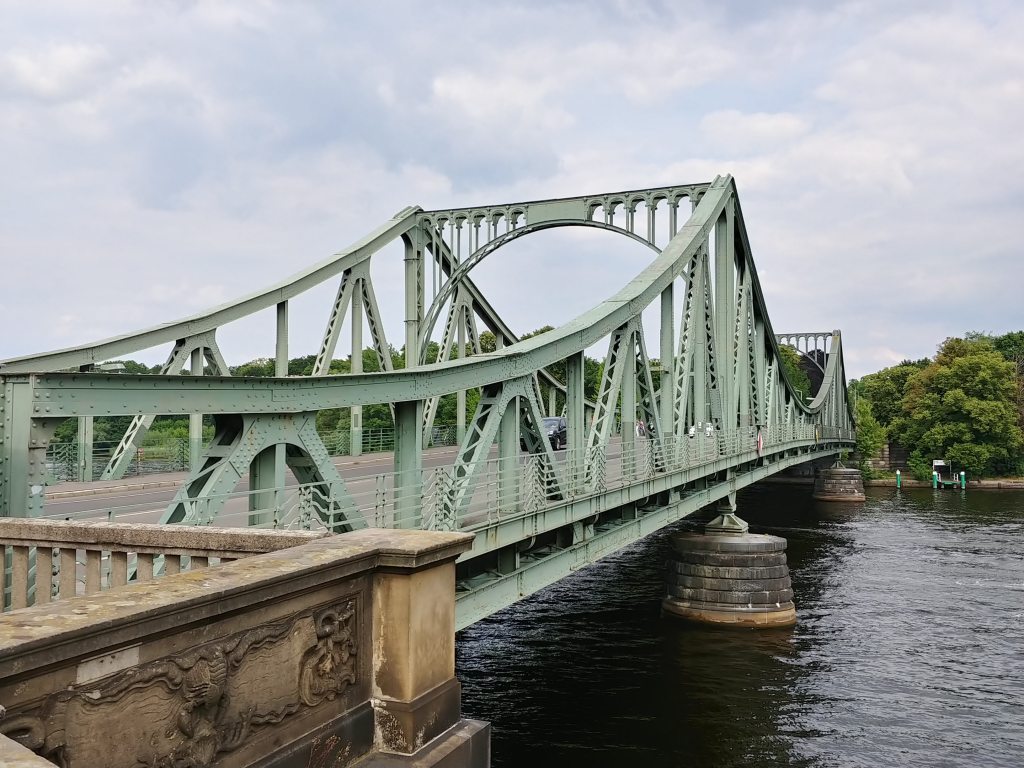
If you take a day trip from Berlin to Potsdam, take time out from visiting Potsdam’s many palaces to visit the Glienicke Brücke, which is easily accessible by tram from central Potsdam. During the period of German division, the center of this early twentieth-century iron bridge was the border between East Germany and West Berlin (and, as you might already know if you saw the film Bridge of Spies, was the site of several spy exchanges during the Cold War). As you stand on the former border (marked with the simple words “Deutsche Teilung bis 1989,” or “German division until 1989”), ponder the fact that, during German division, the border completely altered the landscape and atmosphere of the many beautiful lakes in this area, transforming them from places where Berliners would come for rest and relaxation to (on the East German side) places of surveillance and distrust, as the East German regime sought to prevent its citizens from fleeing to West Berlin via the lakes. Today, the lakes dividing Potsdam from Berlin are once again a place for rest, relaxation, and recreation, but, not so very long ago, this was a borderland.
If you are in France, travel to the historical regions of Alsace and Lorraine, once a borderland hotly contested between Germany and France. This region changed hands several times over the course of the late nineteenth and twentieth centuries, becoming German after 1871, then French after the First World War, German again during the Nazi occupation of France in the Second World War, and French once more after 1945 (which it remains today). Alsace and Lorraine have become more French since the Second World War, with French, for obvious political reasons, replacing German dialects as the dominant language in the region. Despite this linguistic change, the physical evidence of the region’s former borderland identity remains, especially in the cities of Strasbourg, Colmar, and Metz.

half-timbered buildings, such as these, are found in many German towns and cities.
In Italy, the Trentino-Alto Adige/Südtirol, an autonomous region in the far north of the country, was once – and, in many ways, still is – a borderland. For centuries, this area was ruled by the Austrian Empire, gaining a significant German population. After the First World War, however, the region was annexed to Italy (which it remains part of today). Despite attempts by Mussolini’s regime to Italianize the region by making Italian the sole official language and removing the German names of cities and towns, in addition to other ways of excising the region’s German identity, the region still has a distinct German heritage today.

Indeed, in some areas of the region, German, and not Italian, is still the majority language today. Since Austria’s entry into the European Union, the region has become a new kind of borderland: a Euroregion, promoting cross-border cooperation between the region and the Austrian state of Tirol, directly across the border, which has alleviated discontent and largely eliminated flare-ups of separatist sentiment in the region (as has the decision by the Italian government to grant the region significant autonomy and make both German and Italian official languages). If you find yourself in Italy, take time to visit the cities of Bozen/Bolzano, Meran/Merano, or Brixen/Bressanone, and explore the diverse heritage of this region, as reflected in its landscape and architecture.
In southern Austria, you will find evidence of another borderland, centered around the city of Klagenfurt, which is only 30 miles from the Slovenian border. Since Slovenia itself was part of the Austrian Empire until 1918, there has long been a Slovene minority in the Austrian state of Carinthia (of which Klagenfurt is the capital), making Carinthia very much a borderland region. Indeed, after the First World War, the area was very much contested between the new Austrian republic and the new Kingdom of Yugoslavia. Yugoslav troops actually occupied Klagenfurt from 1919 to 1920, and the question of whether the area would remain Austrian or become part of Yugoslavia was not settled until October 1920, when, in a plebiscite, the majority of residents of this mixed-language area chose to remain part of Austria. Today, with Austria and Slovenia both part of the European Union, this is another stable borderland, though by no means a defunct one. There is still a small Slovene minority in the Austrian state of Carinthia: indeed, the Alpen-Adria-Universität Klagenfurt works to support bi- and multilingualism in the region. You can experience this borderland region for yourself by traveling to Klagenfurt to soak up some Austrian culture, before you hop across the border to Slovenia, where the idyllic Lake Bled area and the lively Slovenian capital of Ljubljana are only short drives away.

So far, all the places I have mentioned are borderland regions, small parts of one or more countries. Luxembourg is a unique place in Europe in that, in many ways, the entire country is a borderland. Sandwiched in between Germany, Belgium, and France, Luxembourg is a crossroads of German and French culture. Indeed, the nation has three official languages: German, French, and Luxembourgish; while not an official language, English is also widely spoken in Luxembourg, which today is one of the official capitals of the European Union. In Luxembourg City, the capital, the architecture is French in style, and French is the dominant written language, but when I popped into a cafe on my most recent visit to the city, a menu written entirely in German, with no translations, was no problem for the patrons. As I wandered through the city, I heard people speaking French, German, English, and what I assumed to be Luxembourgish, and saw posters written mainly in French, but sometimes in Luxembourgish. I left Luxembourg feeling that it has truly embraced its character as a borderland and its cultural/linguistic diversity, as it has profited from both in recent years by becoming a hub for the European Union.
The more you dig into the history of Europe, the more borderlands you discover. The regions mentioned this post represent only a small portion of the borderlands in Europe, places that I have explored or that are on my list of places to explore on future trips to Europe. These are fascinating regions, shaped by their ethnic, cultural, and/or linguistic diversity for centuries. To travel with history in Europe, step into the borderlands and explore what they have to offer.



 Making the Past Present
Leave a comment