Last Saturday morning, while sitting in a coffee shop, reading about conservation policies and the criteria for listing historic buildings in England, I suddenly thought, “what if I went to see Durham Cathedral?” After all, it was Saturday, and Durham Cathedral was on my sightseeing wish list. The next thing I knew, I was at the train station, buying a ticket and catching a train north to Durham.
About an hour north of York by train, Durham is a historic city on the River Wear, founded in the 10th century. While not quite as charming as York – although, admittedly, most places aren’t as charming as York – Durham has one major attraction for visitors: its cathedral, a UNESCO World Heritage Site. Once my train arrived in Durham, I headed down the hill from the train station, across the river, up another hill, through town, and up an even steeper hill to the cathedral.

Most of the major cathedrals in England, such as Westminster Abbey, Canterbury Cathedral, and York Minster, were built in the Gothic style of architecture. Gothic architecture became popular in England in the late 12th and early 13th centuries, replacing the dominant Norman Romanesque style. Gothic architecture is known for its technical innovations, particularly pointed arches, the rib vault, and flying buttresses, all of which allowed Gothic cathedrals to be built taller and with larger windows than their Romanesque predecessors. The architectural features of Gothic cathedrals – pointed arches, large stained-glass windows, and high, vaulted ceilings – were all intended to draw worshipers’ eyes up toward heaven.
I explain all of this to say that Durham Cathedral is an unusual English cathedral, because it was never rebuilt in the Gothic style. It is one of the few remaining Norman Romanesque cathedrals in England, and is considered one of the finest examples of Norman architecture in Europe.

The distinguishing features of Romanesque architecture are round arches, sturdy pillars, barrel vaults, large towers, and decorative arcading. Romanesque cathedrals tend to be darker inside than Gothic cathedrals, as rounded arches and barrel vaults can’t support the weight of large windows. Although, in terms of architectural history, Romanesque is a less technically advanced style of building than Gothic, that doesn’t make Durham Cathedral any less magnificent.

The cathedral has many interesting architectural features. As you can see in the pictures to the left and right, the central columns in the nave are patterned, in a way that is reminiscent of Byzantine architecture. (That is entirely possible, as ideas circulated throughout medieval Europe and the Byzantine Empire, which survived until 1453.) Durham Cathedral contains the shrine of St. Cuthbert, an Anglo-Saxon monk who became one of the most important medieval saints in northern England. While the interior of the cathedral is noticeably darker than that of York Minster, it wasn’t gloomy, partially due to the modern wonder of strategically placed electric lighting and partially because the cathedral has a number of stained glass windows, including several modern windows, that let natural light in.

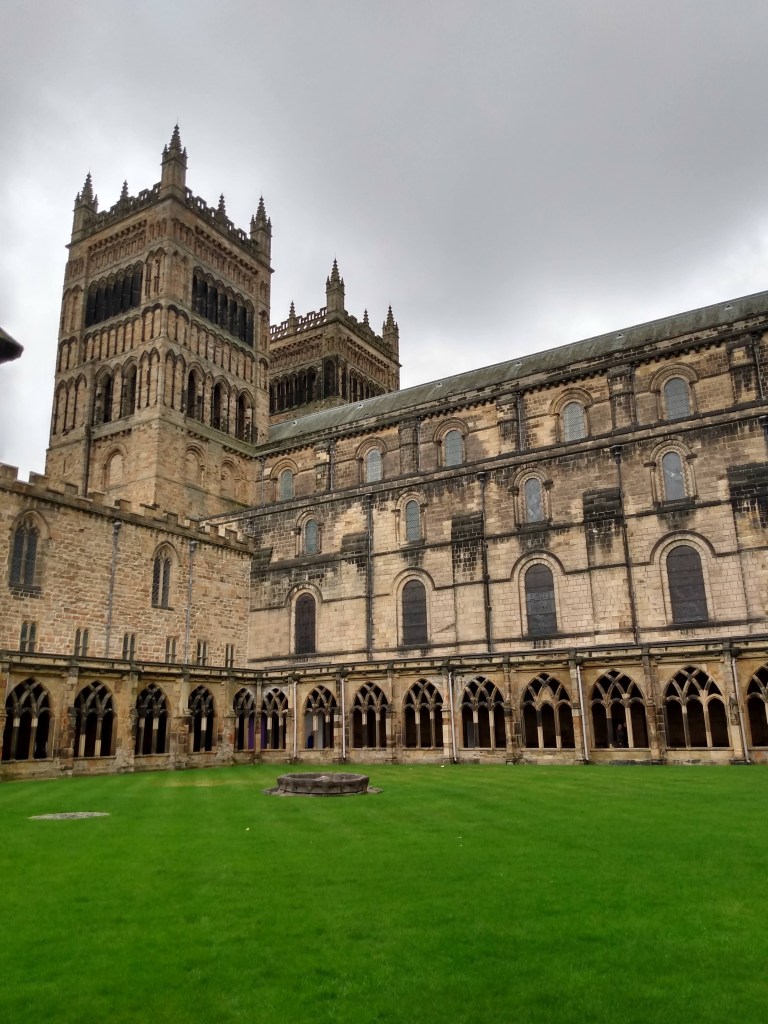
Durham Cathedral is more than just a cathedral building: it is a cathedral complex. Beyond the cathedral itself, Durham Cathedral has one of the best-preserved medieval monastic complexes in England. (Most monastic complexes did not survive Henry VIII’s Dissolution of the Monasteries in the 1530s.) A side door leads from the cathedral to the cloister, where, prior to the Reformation, the monks of the cathedral would have eaten, studied, slept, and gone about their business. I walked all around the cloister, but wasn’t able to go inside the chapter house, as there was an auction going on inside. I think they were auctioning off stones from part of the cathedral to raise money for restoration work being done on one of the chapels.

As I was leaving Durham Cathedral, there was one last thing to see: the tomb of Bede. Bede was an Anglo-Saxon monk who lived in the Kingdom of Northumbria, one of the seven Anglo-Saxon kingdoms, in the late 7th and early 8th centuries. Bede was a scholar who wrote the Ecclesiastical History of the English People, completed around 731. It is one of the most important written sources from the Anglo-Saxon period and has been called one of the first works of English history. I remember reading parts of Bede’s Ecclesiastical History when I studied abroad in Cambridge, since the classes were on early British history.
After leaving the cathedral, I was going to explore more of Durham before heading back to York, but I hadn’t made it farther than the riverside when it started to rain rather heavily. I persevered for a little while, but when it became seriously unpleasant (as opposed to a minor inconvenience), I headed back to the train station and hopped on the next train back to York. The rain notwithstanding, my trip to Durham was a very good spontaneous Saturday adventure!



 Making the Past Present
Leave a comment