A few months ago, I highlighted the amazing collection of Roman remains in Trier, Germany. Located in the western German state of Rhineland-Palatinate, near Germany’s border with Luxembourg and France (see map below), Trier is believed to be Germany’s oldest city – hence, the collection of Roman sites, including an amphitheater, several bath complexes, a bridge, a palace basilica, and a city gate. These sites speak to an important period of Trier’s history, when the city (called Augusta Treverorum) was an important Roman provincial capital. But what happened in Trier after the Romans left? And what sites are associated with Trier’s modern history (relatively speaking, of course)? Read on to find out how Augusta Treverorum became Trier!
From Augusta Treverorum to Trier
In the 5th century AD, Trier was seized by the Franks, ending the era of Roman control of the city. Throughout the 5th century, as Roman power in Europe slowly collapsed, Germanic tribes, such as the Franks, attacked the frontier regions of the Roman Empire, seeking to gain control of these areas. Augusta Treverorum was sacked at least four times by the Franks in the early 5th century and, by 485, the city was definitely under Frankish control. One era in Trier’s history had ended, and a new one was beginning.
For several centuries, Trier was part of the Frankish empire, which was ruled first by the Merovingian dynasty and later by the Carolingian dynasty. The most famous Carolingian ruler was the emperor Charlemagne, who, in the early 800s, created and ruled a vast empire in western and central Europe. After Charlemagne’s death in 814, his empire began to split apart; by the late 800s, the Carolingian Empire had broken apart. The western part of the kingdom became the forerunner of the kingdom of France, while the eastern part of the empire (including Trier) became the forerunner of the Holy Roman Empire (or medieval Germany).

From the 1100s onwards, Trier was ruled by an Archbishop-Elector. The Archbishop of Trier, who ruled over the city and the surrounding area, was one of the seven Electors of the Holy Roman Empire, the rulers who, as the name suggests, elected the Holy Roman Emperor. The Archbishop-Electors of Trier had their official residence in the city of Trier until the 1600s, when they relocated to a castle overlooking the city of Koblenz. The Electorate of Trier would be an independent state within the Holy Roman Empire for several centuries. In 1473, the University of Trier was founded; it was closed in 1798 during the French occupation of Trier and did not reopen until 1970.

From the 1600s until the early 1800s, Trier’s location in the borderland region between the German states and France became a liability, as the city was invaded and occupied multiple times by French armies during a period of near-constant warfare in Europe. French soldiers besieged and occupied Trier three times during the Thirty Years’ War (1618-1648). The French again invaded and occupied Trier in 1684. In 1689, during the War of the League of Augsburg, King Louis XIV of France ordered the destruction of Trier’s castles and bridges, though the city itself was spared. During the War of the Spanish Succession, French armies occupied Trier in 1702 and from 1705 to 1714. After a short respite from being invaded and occupied, Trier was captured by the French army in 1794, during the French Revolutionary Wars. The city of Trier was incorporated into France, and the University of Trier was closed.
In 1806, Napoleon dissolved the Holy Roman Empire, a move which had a lasting impact on Trier. With the end of the Holy Roman Empire, the Archbishop-Elector of Trier lost his power, and the Electorate of Trier disappeared from the map of Europe. After Napoleon’s defeat in 1815, the city of Trier and the surrounding area became part of the Kingdom of Prussia. In 1871, Trier became part of the newly-unified German Empire.

During the Second World War, Trier was damaged by Allied bombing and, later, by artillery bombardments as Allied armies advanced into Germany. Trier surrendered to the U.S. Army on March 2, 1945, although the city later became part of the French zone of occupation. In 1949, Trier became part of the new Federal Republic of Germany.
“Modern” Sites in Trier
What sites are associated with Trier’s modern history (relatively speaking, of course)? Quite a few, actually. Here are some of the most interesting “modern” sites in Trier.
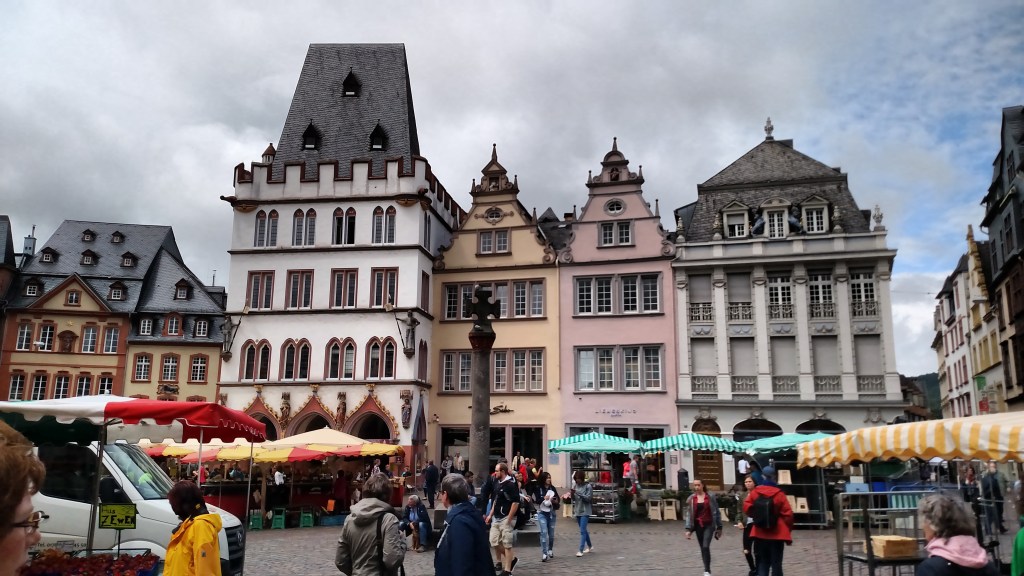
The Hauptmarkt is Trier’s central square. The market cross (seen in the middle of the picture above) dates to 958. Six major streets converge at the Hauptmarkt.
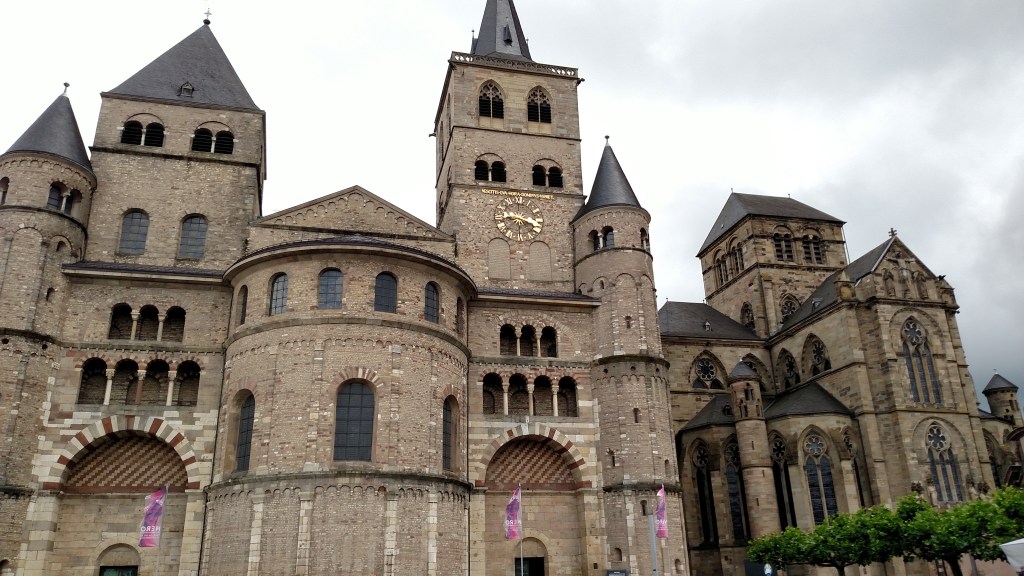
The Trierer Dom (Trier Cathedral) and Liebfrauenkirche are adjacent (and adjoining) churches near the Hauptmarkt. The Trierer Dom, which sits on the foundations of ancient Roman buildings, was built in the Romanesque architectural style. The current cathedral, built to replace an earlier cathedral destroyed by the Vikings in 882, was completed in 1270. Over the centuries, the cathedral has acquired some Gothic and Baroque architectural elements, such as pointed vaults (a classic Gothic element) and an elaborate Baroque chapel near the nave, but the overall style remains Romanesque.
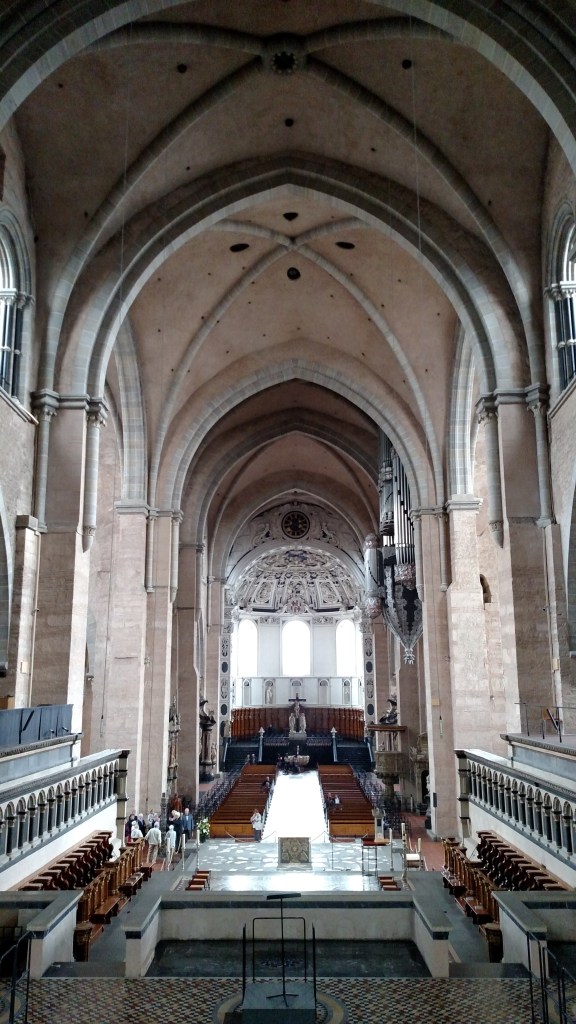

Directly adjacent to the Trierer Dom is the Liebfrauenkirche, which also dates to the 13th century, but was built in the Gothic style of architecture. The Liebfrauenkirche is one of the earliest Gothic churches in Germany. Like the Trierer Dom, it sits on the foundations of Roman buildings.


A visit to the Trierer Dom and the Liebfrauenkirche is a journey through architectural history, with the earlier Romanesque style of the Dom giving way to the Gothic style of the Liebfrauenkirche.
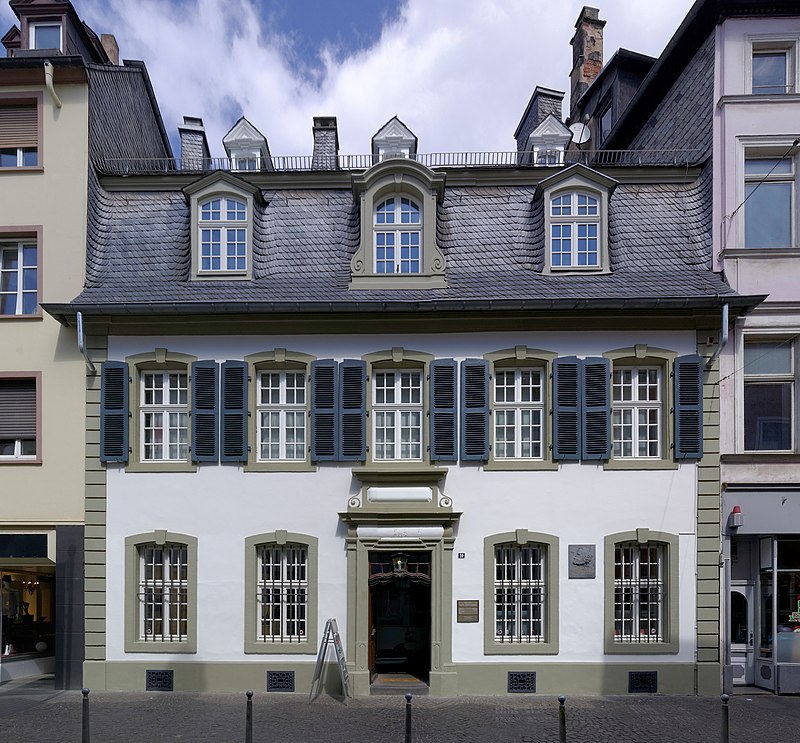
Another noteworthy site in Trier is the Karl-Marx-Haus (Karl Marx House). Marx, the author of The Communist Manifesto and founder of Marxism, was born in this house in Trier in 1818. Today it is a museum, with exhibits on Marx’s life, ideas, and writings, as well as the history of socialism and communism more generally. The house was purchased by the Social Democratic Party of Germany (SPD) in 1928 and opened as a museum in 1947. It is currently operated by the Friedrich-Ebert-Stiftung, a foundation closely associated with the SPD.
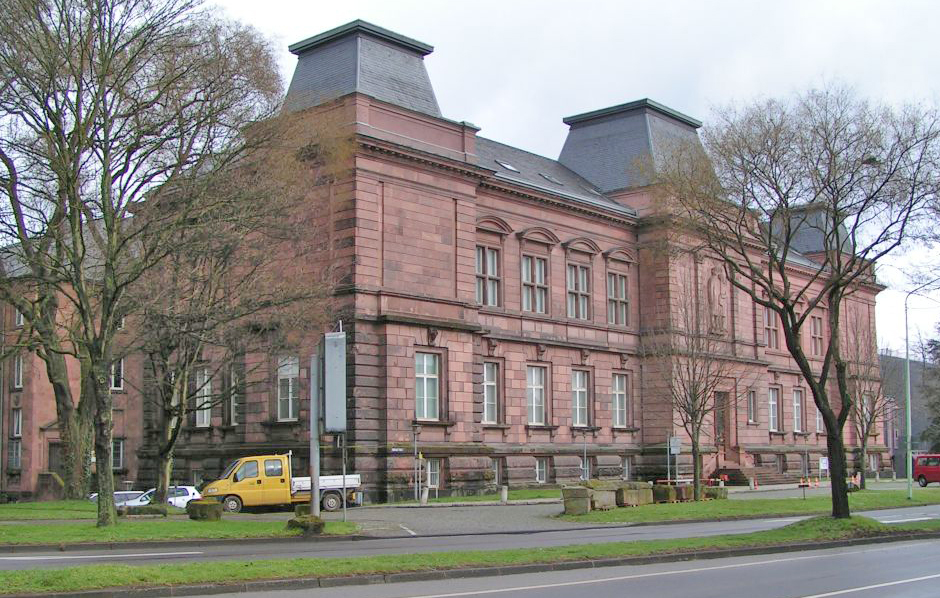
The Rheinisches Landesmuseum Trier, founded in 1877 and housed near the former residence of the Archbishop-Elector of Trier, is an archaeological museum with collections stretching from prehistory to the late Middle Ages. Understandably, given Trier’s history, the museum has a major focus on Roman artifacts and Roman history. A visit to the Rheinisches Landesmuseum is a perfect complement to visits to Trier’s Roman sites, allowing you to learn more about Trier’s fascinating history.
I hope that this post, as well as my earlier tour of Roman Trier, have given you an idea of all that this fascinating city has to offer. Whenever you’re able to travel to Germany again, Trier is definitely worth a day or two of your time!



 Making the Past Present
Leave a comment