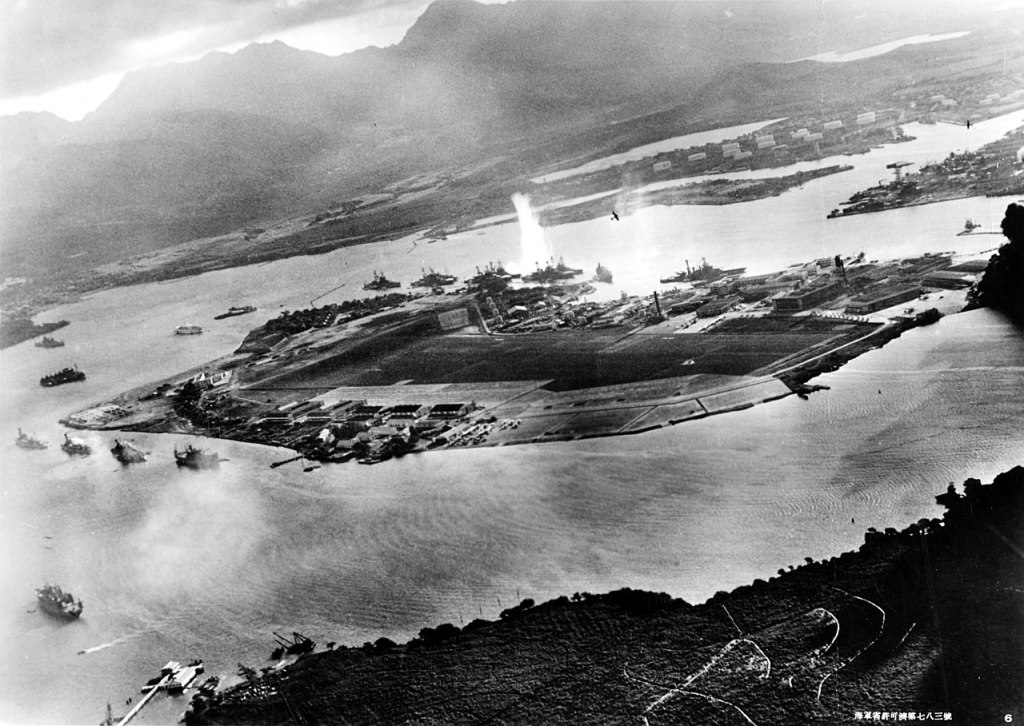
The first twelve days of December 1941, as historian Evan Mawdsley vividly describes in his book December 1941: Twelve Days that Began a World War, changed the world forever. In these twelve days, the German army was stopped in front of Moscow, ending Operation Barbarossa; Japan attacked American and British territories in the Pacific and Southeast Asia; the United States entered the war; and Nazi leaders began planning for the deportation and murder of all European Jews.

To chart these momentous events of December 1 to December 12, 1941, and the decisions that lay behind them, Mawdsley adopts a chronological, day-by-day, place-by-place, event-by-event approach. Each chapter of December 1941 covers just one day in time, beginning where the calendar day begins, in the Central Pacific, and then moving westward. Events in the Philippines, Malaya, and Japan are thus discussed first, followed by Moscow, Berlin, and Rome, then London, and finally the United States.
As strange as it may sound, Mawdsley’s strictly chronological approach to writing history is actually quite unusual for a book written by an academic historian. Most academic histories written today are broadly chronological, moving forward through a particular period of history, but specifically organized around themes. In these histories, the order of events is less important than broad patterns or major developments in a particular place during a particular period. For the majority of historical periods, this approach works very well. Mawdsley reminds us, however, that there are periods in history where it is very important to know that Event A happened before Event B or that Event C caused Leader X to make such-and-such decision. His day-by-day, event-by-event, decision-by-decision approach reminds us that nothing in history is ever certain.
In my opinion, this is something that many people – historians included – tend to forget. Too often we look back on the past and think, well, of course, the Japanese bombed Pearl Harbor, or the Germans lost the Battle of Moscow, because that’s what happened. We forget that people at the time had no idea what was going to happen one day, one month, or one year in the future. All they could do was make decisions based on the information available to them at the time and their own worldviews.
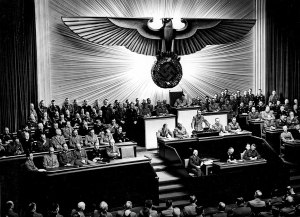
For example, when Franklin D. Roosevelt gave his famous “Date of Infamy” speech to Congress on December 8, 1941, requesting a declaration of war against Japan, he didn’t know that the United States would win the war and emerge a global superpower. When the British failed to defend Malaya against Japanese attack in December 1941 and then lost Singapore in February 1942, they didn’t know that those events were the beginning of the end of the British Empire. When General Zhukov began the Red Army’s counterattack against the Germans in front of Moscow on December 6, 1941, he had no idea that he was setting in motion a string of events that would ultimately lead to Soviet victory on the Eastern Front. When Hitler declared war on the United States on December 11, 1941, he didn’t know that the American entry into World War II would ultimately lead to Nazi defeat.
December 1941 reminds us that nothing in history is inevitable, that everything depends on choices being made by people in particular times and places. When those choices are laid out in a day-by-day, moment-by-moment account such as Mawdsley’s, we can see how one decision made differently might have changed the course of history. If, for example, the U.S. Navy did not decide to reinforce Pacific outposts such as Wake Island and Midway in early December 1941, based on a growing belief that the Japanese were planning for war sometime in the near future, the American aircraft carriers most likely would have been destroyed during the Pearl Harbor attack. If American navy and army commanders had not misinterpreted or ignored several key pieces of intelligence on the morning of December 7, the commanders on the ground at Pearl Harbor might have had a few hours’ warning of an impending attack. And so on.
Mawdsley also shows us that all of the events of December 1941 were interconnected and only truly make sense when taken together. These events are often taught separately: Pearl Harbor in a U.S. History class, the Battle of Moscow in a European history class, etc. However, no one at the time thought of these events as happening in distant, unrelated areas of the world. For example, Germany, Italy, and Japan created the Tripartite Pact (a global alliance, at least in theory) to defeat Britain and keep the United States out of the war, believing that the U.S. would not want to fight everywhere around the world. In the end, though, when Japan attacked the U.S. on December 7, the existence of the Tripartite Pact caused Germany and Italy to declare war on the United States, beginning a global war.
To take another example, Japanese leaders made the decision to go to war with the United States by attacking U.S. possessions in the Philippines and the eastern Pacific, because they wanted the natural resources of the British and Dutch colonies in Southeast Asia, and the security of the Japanese empire required the capture of the Philippines. The reason the Japanese decided to invade the British and Dutch colonies was because of the war in Europe: the Netherlands was occupied by Germany, Britain was concerned with developments in the European Theater, and the Soviet Union (Britain’s ally) was preoccupied with fighting off the Nazis. In December 1941, everything was interconnected.
If more academic historians truly want to make their work for accessible for non-academic readers, they should follow Mawdsley’s example and consider taking a chronological approach to writing history. December 1941 is not the only period in history that lends itself to a day-by-day or week-by-week account. The July Crisis in 1914 is a prime example of this, although there already is at least one semi-chronological account of this period, David Fromkin’s book Europe’s Last Summer: Who Started the Great War in 1914?. Another period that seems tailor-made for chronological histories is the summer and fall of 1989, when the Soviet bloc fell apart. Other ideas include:
- June 1944, when the Allies launched two major offensives against Germany (the invasion of France and Operation Bagration).
- October and November 1956, when the Suez Crisis and the Hungarian uprising erupted at almost the same time.
- 1968 (the entire year), when protests, uprisings, and unrest broke out around the world.
If you’re interested in World War II, international history, military history, or just well-written history, I highly recommend December 1941. I hope to see more books like this published in the future, books that remind us that hindsight truly is 20/20: that events only appear inevitable when we look back on them from the vantage point of decades or centuries in the future.



 Making the Past Present
Leave a comment