The oldest incorporated town in Tennessee is Jonesborough (see map below), founded in 1779, seventeen years before Tennessee became a state. At the time that Jonesborough was founded, the area that is now Northeast Tennessee was part of North Carolina. The town of Jonesborough was established to provide the increasing number of settlers living on the western side of the Appalachian Mountains with access to a courthouse, enabling them to carry out legal business without having to journey across the mountains.
The founders of Jonesborough wanted to ensure that their town would not look like a frontier outpost. Accordingly, the town was laid out in a grid of 72 lots, following the example of other colonial towns in British North America, such as Williamsburg, Virginia, which had been carefully laid out in a similar fashion. In a further attempt to regulate the appearance of Jonesborough, residents of the town were required to build a brick, stone, or well-framed house: no log cabins allowed. The presence of a log cabin (the Christopher Taylor House) on Main Street today is an anachronism; it was moved to its current location in the 1970s in order to preserve it.
One of the well-framed structures constructed in Jonesborough was the Chester Inn. Built in 1797 by Dr. William P. Chester, the inn has had a long and varied history. The three-story building has always had multiple functions. The ground floor has been home to a variety of commercial spaces, beginning with Dr. Chester’s apothecary and including a barbershop, post office, sandwich shop, the Jonesborough library, and, today, the Chester Inn Museum.

From the late 18th century to the early 20th century, the second and third floors of the building were home to an inn, known at different times as the Chester Inn, the Bell Tavern, the Union Hotel, and the Planters House Hotel. In the early 20th century, around the time of World War I, the inn was converted to a boarding house and, later, to small apartments. By the time that the property was purchased by the State of Tennessee in the late 1980s, most of the original internal configuration of the building had been lost, as walls had been moved and the layout of rooms rearranged.
Because of this, the Chester Inn that visitors to Jonesborough see today is a restoration. After the building was acquired by the state, the decision was made to restore the exterior to its appearance around 1890, just after the last major change to the exterior (the addition of the porch) was made. Restoring the building to its appearance in 1797 would have required demolishing half of the current structure (the inn was expanded in the 1830s), which would not have advanced the goal of preserving the structure.
During the restoration of the Chester Inn, the interior of the building was converted into three distinct spaces: the Chester Inn Museum on the ground floor, which interprets the history of the town and the region from the late 18th century to the 20th century; three restored rooms of the original inn; and office space for the neighboring International Storytelling Center.
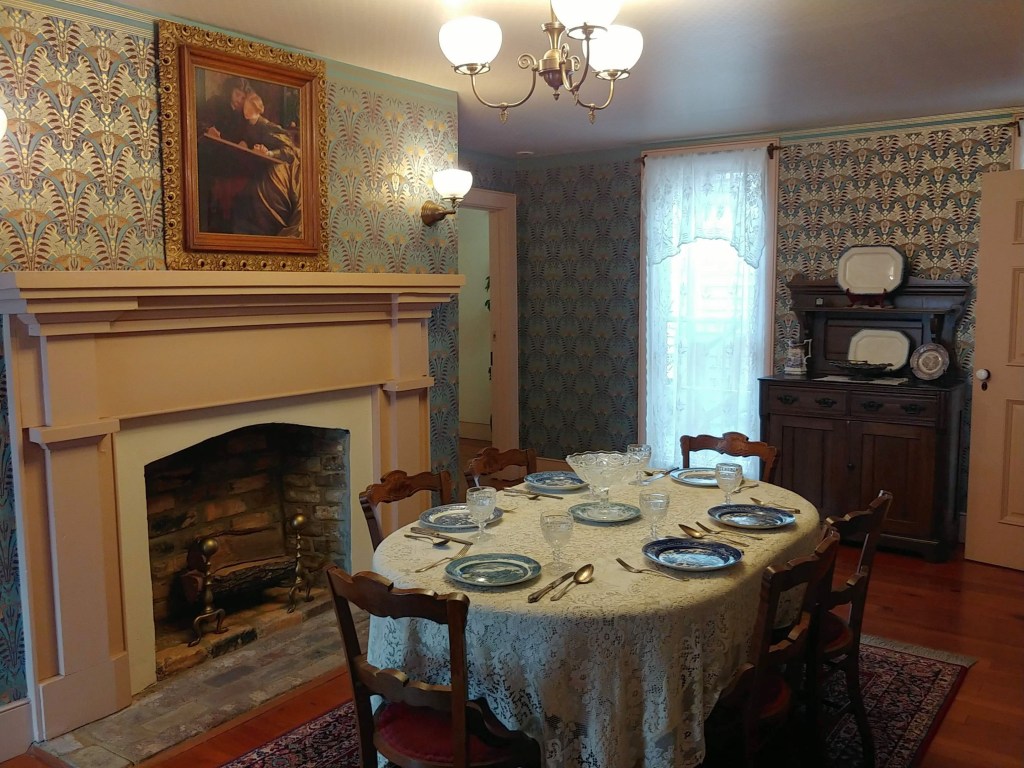
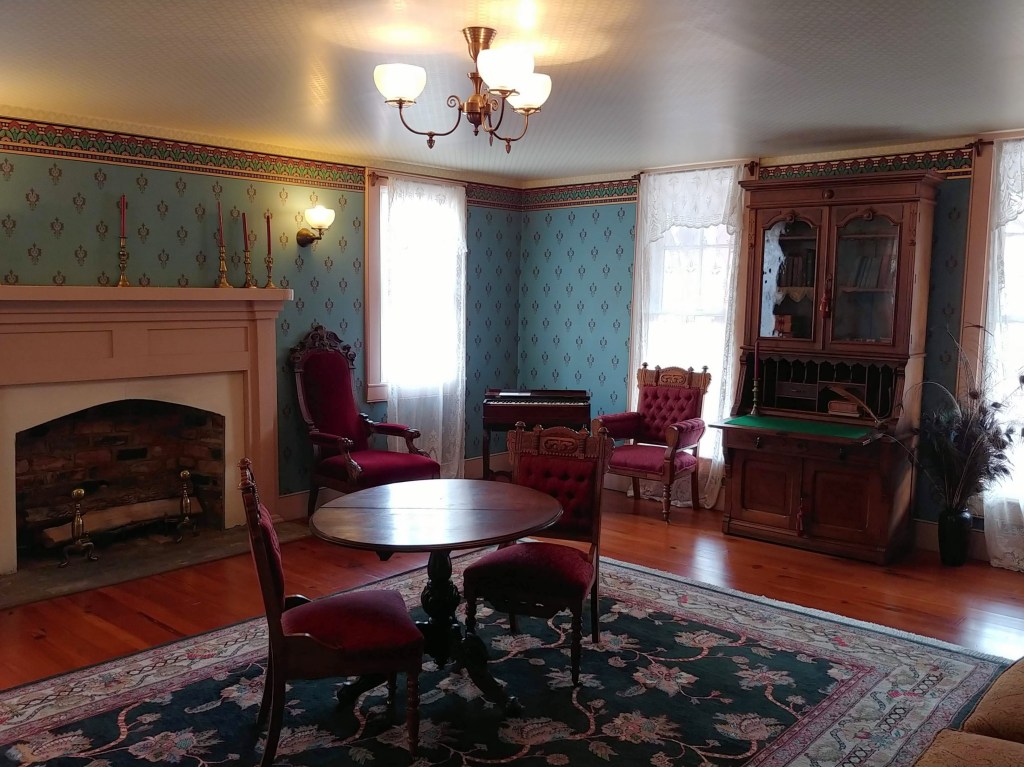
The three restored rooms of the original inn are located on the second and third floors of the building. Open to visitors by guided tour, these rooms showcase what the inn’s dining room, parlor, and guest rooms may have looked like in the 1890s. “May have” is important here, because no photographs of the inn’s interior in the 19th or 20th centuries have ever been discovered. The restoration of the dining room, parlor, and lodging room was carefully based on photographs of other Victorian interiors and knowledge of Victorian decorating customs.
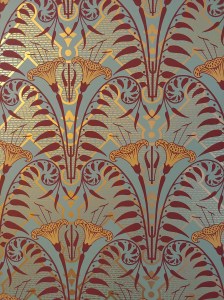
All of the furnishings in the three rooms are original to the Victorian era, just not to the inn itself. The colorful (and bold) wallpaper which adorns the walls is an authentic reproduction of Victorian wallpaper. The light fixtures are electric reproductions of Victorian gas lamps, complete with intricate patterning on the glass. So, although the interiors at the Chester Inn today may not be the same interiors that existed in the inn in the 1890s, visitors to these restored spaces are still able to gain an appreciation of Victorian decorating and, more importantly, to learn how people used these rooms, not just in the Victorian era, but throughout the 19th century.
Tours of the Chester Inn’s restored rooms cover a variety of topics, including the relationship between the inn and the town, advertising, the history of travel, the development of the inn over time, and labor, both free and unfree. While tours generally center around the Victorian period, the conversation moves forward and backward in time as appropriate. For instance, in the dining room, visitors learn about the history of slavery at the Chester Inn and confront the fact that, before the Civil War, much of the labor at the inn, such as the preparation and serving of food, would have been done by enslaved people.
In the parlor, while the conversation focuses on Victorian entertainments, an engraving of the Lincoln family on the back wall invites discussion of the Civil War in East Tennessee, particularly the sharply divided sympathies of the local population. During the Civil War, the inn changed its name to the Union Hotel, communicating the political leanings of its owners at the time.
In the lodging room, visitors learn that, in the late 18th and early 19th centuries, as many as 15 or 20 (male) travelers might have shared this space! Here the conversation focuses on the changing patterns of travel in the 19th century, due to the growth of the middle class and the expansion of leisure time. By the 1890s, staying in an inn had become a much less communal experience, as the furnishing of this room suggests.

With its focus on the Victorian era, the Chester Inn sets itself apart from other historic sites in Northeast Tennessee, which tend to focus on the colonial period and the early 19th century. For example, Sycamore Shoals State Historic Park in Elizabethton interprets the early history of European settlement in what is now East Tennessee and the American Revolution. Similarly, the interpretation at Rocky Mount State Historic Site in Piney Flats focuses on the 1790s, when Rocky Mount served briefly as the territorial capital of what would become Tennessee.
Additionally, the Chester Inn also sets itself apart from the main historical narrative in Jonesborough, which, again, emphasizes the late 18th and early 19th centuries. For example, a historical marker informs visitors about future president Andrew Jackson’s brief residency in Jonesborough in the 1780s. Another historical marker highlights Jonesborough’s connection to the early 19th century abolitionist movement, as The Emancipator, the first newspaper in the United States devoted exclusively to the abolition of slavery, was published in Jonesborough in 1820 by Elihu Embree. Without taking a tour of the town, visitors may not learn much about the history of Jonesborough beyond the early 19th century.
The history of Jonesborough and the Chester Inn reminds us of an important fact: all historic sites have many layers of history. Part of the process of interpretation at these sites – part of the job of public historians – is choosing which layer of history to emphasize. Sometimes, this is an obvious choice. Mount Vernon, naturally, emphasizes the history of George Washington, his family, and his enslaved people. Other times, the choice of which historical layer to emphasize is less obvious and requires more thought on the part of the site’s managers. Whichever period a site chooses to emphasize, the key is to explain to visitors why that particular period of history is being interpreted at the site, so that visitors understand that this was a conscious decision as part of the process of “doing history.”
The Chester Inn, therefore, does important historical work. By bringing the narrative of Jonesborough’s history into the late 19th century, it reminds visitors that Jonesborough did not remain static, forever a colonial town on the Appalachian frontier. Rather, the town – and its buildings – have many layers of history for visitors to discover.



 Making the Past Present
Leave a comment