
Just after Christmas, I was in Charleston, South Carolina, one of my favorite cities. When it comes to history, Charleston is most commonly associated with the colonial period and the American Revolution (the 1780 surrender of Charleston to the British was one of the worst defeats for the Continental Army during the Revolutionary War), the history of slavery in America (including the slave trade and the development of the plantation system in South Carolina), and the Civil War (the first shots of which were fired from The Battery in downtown Charleston toward Fort Sumter in the harbor). While this is already a lot of history for one city to be associated with, there is even more to discover about Charleston’s history, as I learned on my most recent trip.
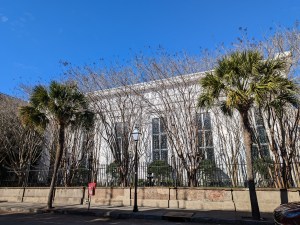
Wanting to explore a new side to Charleston’s history, I booked a tour of Charleston’s oldest synagogue, Kahal Kadosh Beth Elohim, located in downtown Charleston on Hasell Street, not too far from the historic city market. My tour revealed a great deal about the history of Charleston’s Jewish community in general and the KKBE (as it is abbreviated) congregation in particular, history that I had not encountered before. I learned that there has been a Jewish community in Charleston for almost as long as the city has existed. Jews arrived in Charleston during the colonial period, having emigrated to South Carolina from Britain and Britain’s Caribbean colonies. The colonial authorities in South Carolina welcomed Jews into the colony as traders and merchants and afforded them more religious liberty than in other colonies or parts of Europe at the time. Many of the first Jews to settle in Charleston were Sephardic Jews, the descendants of Jews who had been expelled from Spain and Portugal in the late 15th century, some of whom settled in England. From the late 18th century onward, most of the Jews who emigrated to Charleston were Ashkenazi Jews from Germany and Eastern Europe, although Sephardic Jews remained culturally dominant in Charleston’s Jewish community into the 19th century.
Kahal Kadosh Beth Elohim, the first Jewish congregation in Charleston, was organized in 1749, and the congregation dedicated its first synagogue building in 1794. The founding date of KKBE places it among the oldest Jewish congregations in the United States, one of the six congregations founded before 1789. The others are Shearith Israel in New York City (1654), Touro Synagogue in Rhode Island (c. 1658), Mickve Israel in Savannah (1733), Mikveh Israel in Philadelphia (1740), and Kahal Kadosh Beth Shalome in Richmond, Virginia (1789).
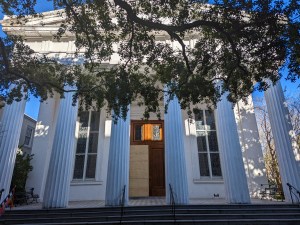
The first synagogue built by the KKBE congregation was completed and dedicated in 1794. It was constructed in the popular Georgian style, and surviving drawings of the synagogue’s exterior reveal that it looked strikingly like a church, complete with a cupola that resembled a spire. My tour guide suggested two possible explanations for this architecture: perhaps, when it came to religious buildings, architects in 1790s South Carolina were only familiar with constructing churches, or the KKBE congregation wanted their synagogue to “fit in,” at least externally, with the prevailing architecture of the city. This first synagogue was destroyed by fire in 1838. In 1841, a second synagogue constructed in the Greek Revival style was dedicated; this is the synagogue still in use by the KKBE congregation today. It is the second-oldest synagogue building in the United States and the oldest in continuous use. The building has been designated a National Historic Landmark and is on the National Register of Historic Places.
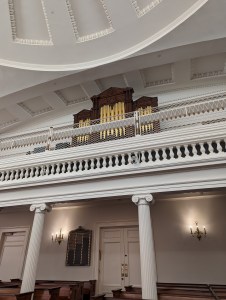
In addition to being home to one of the country’s oldest Jewish communities, Charleston is also considered to be the birthplace of Reform Judaism in the United States. In 1824, a group of congregants petitioned the leaders of KKBE to change the Sephardic Orthodox liturgy that was then in use. They wanted shorter services, prayers in English as well as Hebrew, and a sermon in English. When their petition was denied, the reformers broke with the congregation and founded the Reformed Society of Israelites, many of the practices and principles of which have become part of American Reform Judaism. After nine years, the reformers rejoined the KKBE congregation and persuaded a majority of the congregation to introduce reforms, including the installation of an organ during the construction of the new synagogue.
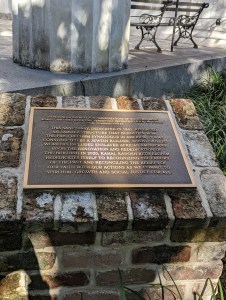
Another aspect of Charleston’s Jewish history that I discovered while at KKBE is that the history of the Jewish community in Charleston, as with Jewish communities throughout the southern United States before the Civil War, is closely intertwined with the history of slavery. While most southern Jews lived in towns and cities, some owned plantations and thus participated in the system of enslaved labor that dominated the southern economy. This history is connected to KKBE in several ways. The current synagogue building was constructed by David Lopez, a Jewish builder, whose skilled laborers included enslaved people. Following extensive renovations and the rededication of the building in 2020, KKBE installed a plaque outside of the building that acknowledges this history. Another way in which the history of slavery is connected to KKBE is through Judah P. Benjamin, a member of the congregation, who was the first American Jew to be elected to the Senate. Benjamin was also a slaveowner who served as Attorney General, Secretary of War, and Secretary of State for the Confederacy during the Civil War. After the Civil War, Benjamin fled to Britain, where he lived and worked as a lawyer for the rest of his life.
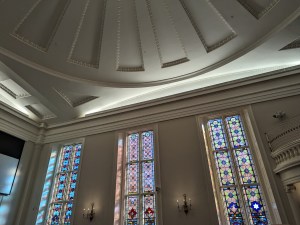
The history of Charleston’s Jewish community obviously does not end with the Civil War. In the late 19th and early 20th centuries, many Eastern European Jews emigrated to Charleston, greatly increasing the city’s Jewish population. Many of these immigrants founded small businesses on King Street, one of Charleston’s major commercial thoroughfares; they also founded a second Orthodox synagogue (the first had been founded by traditionalists who left KKBE when the organ was installed and other reforms instituted). As for KKBE specifically, the synagogue building suffered damage in the Great Earthquake of 1886, which destroyed the former women’s balconies (not in use since 1879) and the windows in the sanctuary. While the balconies were not replaced, stained glass windows were commissioned to replace the plain windows that had been destroyed in the earthquake.
In the 20th century, in the face of antisemitism which barred Jews from joining certain country clubs and organizations, South Carolinian Jews responded by forming their own social and athletic organizations. In addition to this social exclusion, the reality of antisemitism in the United States was demonstrated by events such as the lynching of Leo Frank in 1915 and the re-founding of the Ku Klux Klan that same year with an antisemitic agenda. Given this rise in antisemitism, as well as world events, Jews from Charleston and across the South sought to demonstrate their loyalty to the United States; many of them fought in World War I and World War II. During the civil rights movement of the 1950s and 1960s, many American Jews supported African Americans’ fight for civil rights and worked together with Black Americans on the Freedom Summer and other projects. In the South, some Jews who supported the civil rights movement tried to keep a low profile in order to avoid attracting the attention of the KKK. However, some southern Jews opposed the civil rights movement, as, despite antisemitism, Jews had been on the “right” side of the color line during Jim Crow. This connects to the history of KKBE, as the synagogue’s rabbi in the 1960s, who was an active supporter of the civil rights movement, was forced to resign under pressure from prominent members of the congregation. Perhaps not surprisingly, this history was not mentioned by my tour guide. While KKBE’s acknowledgment of the enslaved laborers who built the synagogue is a step in the right direction, there are clearly other difficult aspects of its history that must be acknowledged.



 Making the Past Present
Leave a comment