
Vienna is a city that strives to sell a romanticized, idealized version of the past, especially at its major tourist attractions: the Hofburg and Schönbrunn Palace, the former residences of the Habsburg imperial family. The foremost myth being sold by Vienna’s tourism industry today is the Sisi myth. Sisi, or Empress Elisabeth of Austria (1837-1898), was the wife of Emperor Franz Joseph (1830-1916), the penultimate Emperor of Austria. Elisabeth (nicknamed “Sisi” by her family) was famously beautiful, supported the Hungarian cause within the Austrian Empire, and suffered a tragic death in 1898 when she was assassinated by an Italian anarchist while traveling in Switzerland. Across Vienna, this basic story – with some added detail – is marketed to tourists in order to draw them in to the Hofburg and Schönbrunn Palace. At the Hofburg in particular, the Sisi myth is central to the tourist experience, as visitors not only tour the state rooms, seeing the places where Elisabeth lived, but also can visit the Sisi Museum. As the name suggests, the Sisi Museum narrates the story of Elisabeth’s life and displays artifacts connected to Elisabeth, such as her gowns. While the Sisi myth does emphasize the tragedy of Elisabeth’s life, its focus on creating a fairy tale narrative to draw in tourists often obscures the true tragedy of Elisabeth’s story.
I was recently reminded of the power of the Sisi myth while browsing Netflix. A show called The Empress popped up in my recommendations; a quick perusal of the summary revealed that it is about the early years of Elisabeth and Franz Joseph’s marriage. I haven’t watched The Empress, so this post is not a critique of the show. Rather, the existence of this show, the tagline of which indicates that it paints Elisabeth and Franz Joseph’s story in a romantic light, demonstrates the staying power of the Sisi myth. The reality, however, is quite different. Instead of a tragic fairy tale (man and woman meet, fall in love, marry, have children, overcome opposition, then woman suffers an untimely death), Elisabeth’s story is more correctly described as that of a deeply unhappy woman dealing with untreated mental illness and, most likely, an eating disorder, who was prevented from raising three of her four children, one of whom later died in a murder-suicide, and who tried to escape her life through incessant travel.

Elisabeth and Franz Joseph’s story is often described as a love match, mainly because Franz Joseph was originally supposed to marry Elisabeth’s older sister, Helene. However, when Franz Joseph first met the teenaged Elisabeth (she was only fifteen at the time), he was so struck with her beauty that he declared he had to marry her. Five days later, Franz Joseph and Elisabeth were engaged; eight months later, they married. Whether Elisabeth ever reciprocated Franz Joseph’s feelings is unknown, but doubtful. Soon after arriving at the Habsburg imperial court in Vienna, Elisabeth began to suffer from ill health, likely brought on by the stress of the very formal, very rigid Hapsburg court life, in contrast to the more informal setting of her childhood in Bavaria. Elisabeth also struggled with the physical realities of marriage (sexual relations and pregnancy); three pregnancies in a little over three years did not help. Elisabeth’s first child, Sophie, was born in 1855, followed by Gisela in 1856 and Rudolf in 1858. All three children were taken away by Elisabeth’s mother-in-law, Archduchess Sophie, who believed that Elisabeth was not a suitable mother and took charge of the upbringing and education of her children. When Elisabeth’s eldest daughter, Sophie, died of illness at the age of two, Elisabeth began to experience periods of heavy depression. Isolated from her children, struggling with depression, and feeling alienated by Habsburg court protocol, Elisabeth’s life was far from a fairy tale.
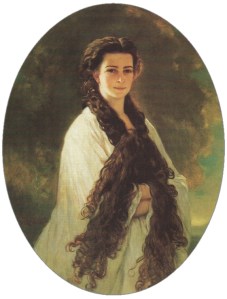
In addition to experiencing periods of depression throughout her life, Elisabeth likely also had an eating disorder, given her extreme focus on preserving her weight through fasting, exercise, and other means, such as steam baths to prevent weight gain. Throughout most of her adult life, Elisabeth consistently fasted and kept up a rigorous exercise regimen, all with the goal of maintaining her weight (which rarely exceeded 110 lbs) and extremely slender waistline, which she further emphasized through tight-lacing, or wearing an extremely tightly-laced corset. To support her almost-obsessive need for exercise, every palace Elisabeth lived in was equipped with a gymnasium, and she also had exercise equipment installed in her bedroom (which is still on display at the Hofburg). An excellent horsewoman, she rode for several hours every day; she also took up fencing in her 50s. Elisabeth’s beauty regimen also took up a great deal of her time, as she spent at least two to three hours each day having her long hair cared for and styled. During the hours spent having her hair styled, Elisabeth studied languages, including Hungarian and Greek; she also spoke English and French.
While the Sisi myth attempts to paint Elisabeth and Franz Joseph’s marriage as a love match, the imperial couple became increasingly distant relatively early in their marriage. Hyper-focused on his duty, Franz Joseph had trouble understanding Elisabeth’s struggle with Habsburg court protocol. From the early 1860s onward, Elisabeth spent less and less time at the court in Vienna, as she sought escape from her life through travel. Travel also provided relief from Elisabeth’s increasing health problems, such as coughing, fever, and migraine, which affected her strongly in Vienna, but improved when she was away from the court, causing some historians to speculate that they may have been stress-induced or psychosomatic. For health reasons and her dislike of sex, Elisabeth sought to avoid becoming pregnant again after Rudolf’s birth. However, in 1868, ten years after Rudolf’s birth, Elisabeth gave birth to another daughter, Marie Valerie. Elisabeth had decided that she wanted a fourth child, a child she could raise herself; she also briefly reconciled with Franz Joseph in order to plead the case of the Hungarians around the time of the Austro-Hungarian Compromise of 1867. Elisabeth raised Marie Valerie herself, without interference from her mother-in-law, although Marie Valerie often felt smothered by Elisabeth’s attention.
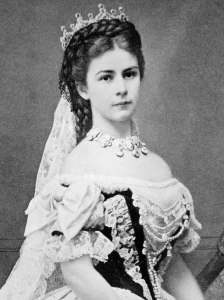
After Marie Valerie’s birth, Elisabeth began to travel more and more frequently, rarely staying in any place for too long. She sought to travel incognito and spent most of her time with her ladies-in-waiting and her language tutors, often working with her language tutors while on lengthy walking tours. Elisabeth also spent a good deal of time reading and writing; she was especially fond of the works of Heinrich Heine, a German poet and radical political thinker, and wrote poetry inspired by Heine’s style, some of which captured her constant restlessness. While Elisabeth was surrounded by wealth and privilege, she was deeply unhappy, hence her constant desire for escape through travel, although it is doubtful whether Elisabeth ever truly felt fulfilled or satisfied by her travels.

In 1889, tragedy struck the Hapsburg imperial family when Crown Prince Rudolf, Franz Joseph and Elisabeth’s only son and the heir to the throne, was found dead at his hunting lodge with his young mistress. The deaths were suspected to be the result of a murder-suicide, which resulted in a great scandal, known as the Mayerling incident, after the name of Rudolf’s hunting lodge. Elisabeth never fully recovered from the death of her son, and in the following years, her depression worsened. Within a few years of Rudolf’s death, Elisabeth’s parents both died, as well as her older sister Helene. Her favorite sister, Sophie, died in a fire in 1897. In the last ten years of her life, Elisabeth spent little time in Vienna, instead traveling endlessly throughout the Mediterranean and Switzerland. Her relationship with Franz Joseph, conducted mostly through correspondence, improved somewhat in the last years of her life.

In 1898, while in Geneva, Switzerland, Elisabeth was assassinated by an Italian anarchist, who stabbed her as she and her lady-in-waiting were boarding a steamship on the shores of Lake Geneva. Her body was returned to Vienna by a funeral train, and she was buried in the Habsburg Imperial Crypt at the Kapuzinerkirche (Capuchin Church) in Vienna. It was a tragic end to a tragic life, one that should not be romanticized for the consumption of tourists and Netflix viewers. By portraying Elisabeth’s story as a fairy tale, albeit one with a tragic ending, the Sisi myth obscures the real tragedy of Elisabeth’s life: her lack of power in the Habsburg court, symbolized by the loss of her three eldest children; her struggle with untreated mental illness and eating disorders; and, fundamentally, the fact that she was thrust into a position (Empress of Austria) for which she was not prepared and not suited by personality. The further tragedy is that Elisabeth was clearly an intelligent woman, fluent in multiple languages, well-read, and creative. At times, she was politically active, pushing Franz Joseph to grant greater political power to Hungary. What more could she have achieved, if she had had the opportunity to more freely express herself, if she had had access to treatment for her depression, and if she had not been hemmed in by the restrictions of the Habsburg court? We can only speculate.




 Making the Past Present
Leave a comment