
While in London today, I visited Kensington Palace, which was a new site for me. I’ve walked past the palace many times during visits to Kensington Gardens, but I’d never actually toured the palace until now. Only part of the palace is open to visitors, since – as royal fans might know – some members of the royal family still live at Kensington Palace. The part of the palace that is open to the public is divided into three sections: the Queen’s State Apartments, the King’s State Apartments, and Victoria: A Royal Childhood. Each section of the palace interprets a different era of royal history, such that visitors to Kensington Palace can learn about three distinct periods in the history of the palace and of the British royal family.
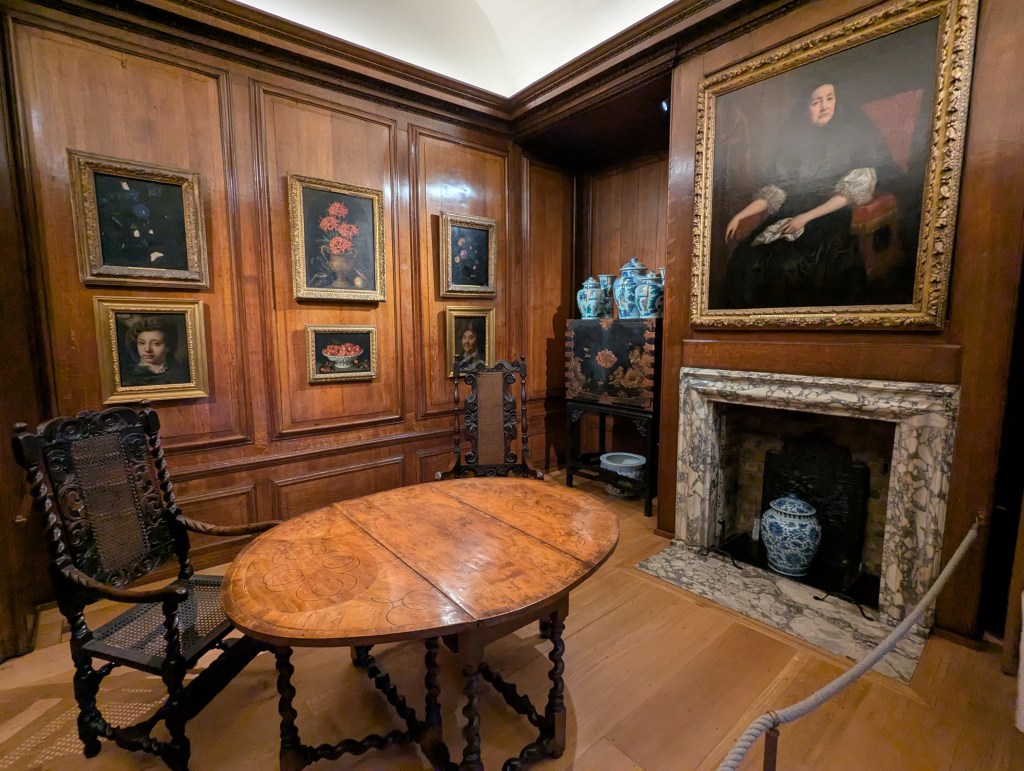
The Queen’s State Apartments are the oldest part of Kensington Palace open to visitors. This series of rooms is decorated and furnished as it might have been during the reign of Queen Mary II (r. 1689-1694), who ruled jointly with her husband, King William III (r. 1689-1702). William and Mary ruled at the end of the Stuart era – they were the next-to-last Stuart monarchs – so the Queen’s State Apartments are furnished in the Stuart style, with some Dutch influences, as William was Dutch by birth. While certainly more elaborate than the average person’s house (either in the 16th century or today), this section of the palace was the least ostentatious. The rooms were paneled with dark wood, and the ceilings were plain, not painted. Based on what I learned from the audio guide, this lack of flashy decoration is partially due to the fact that these were Mary II’s private rooms, where she passed time with her ladies-in-waiting and dined privately with her husband, not rooms where she received courtiers or government ministers.
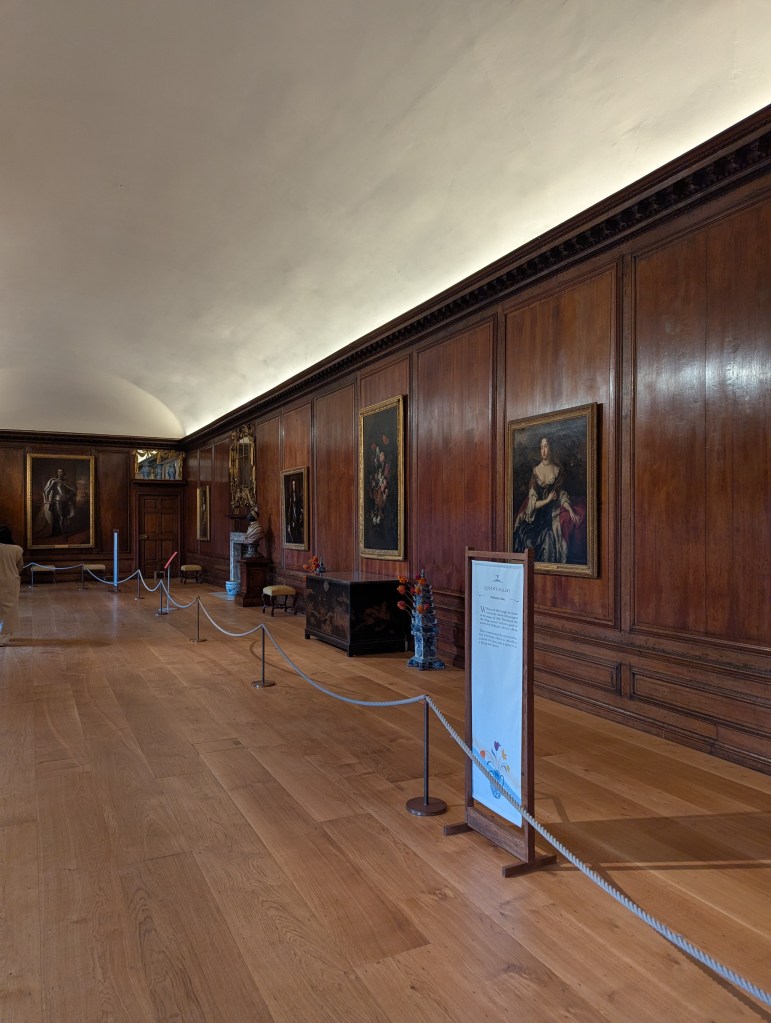
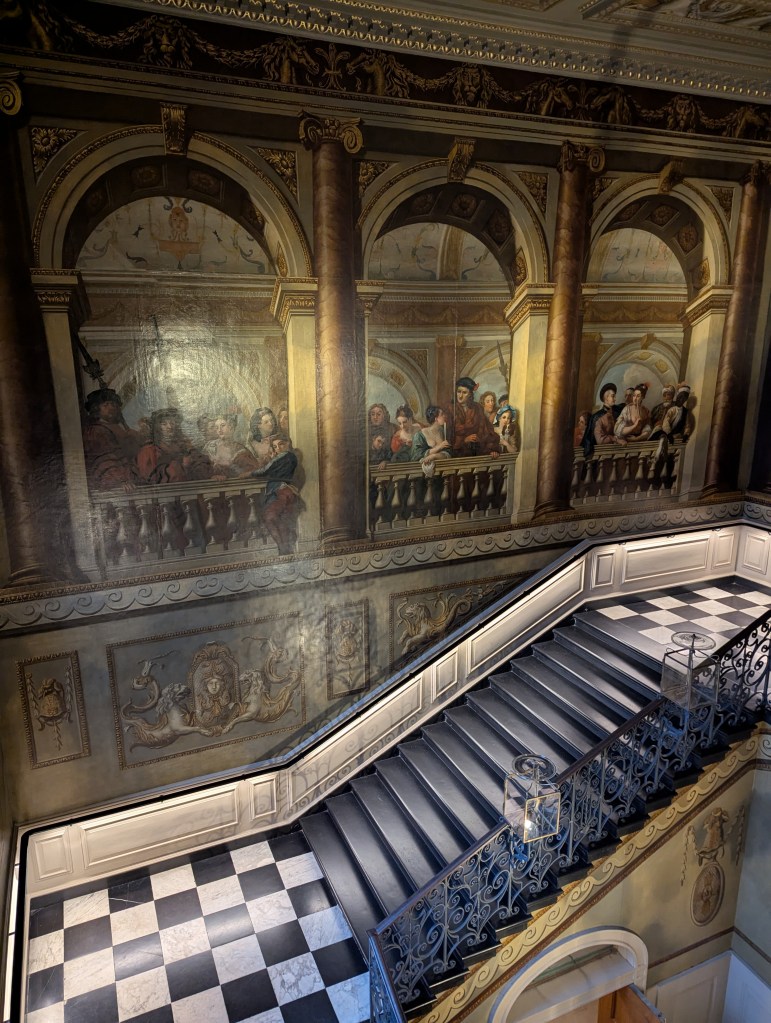
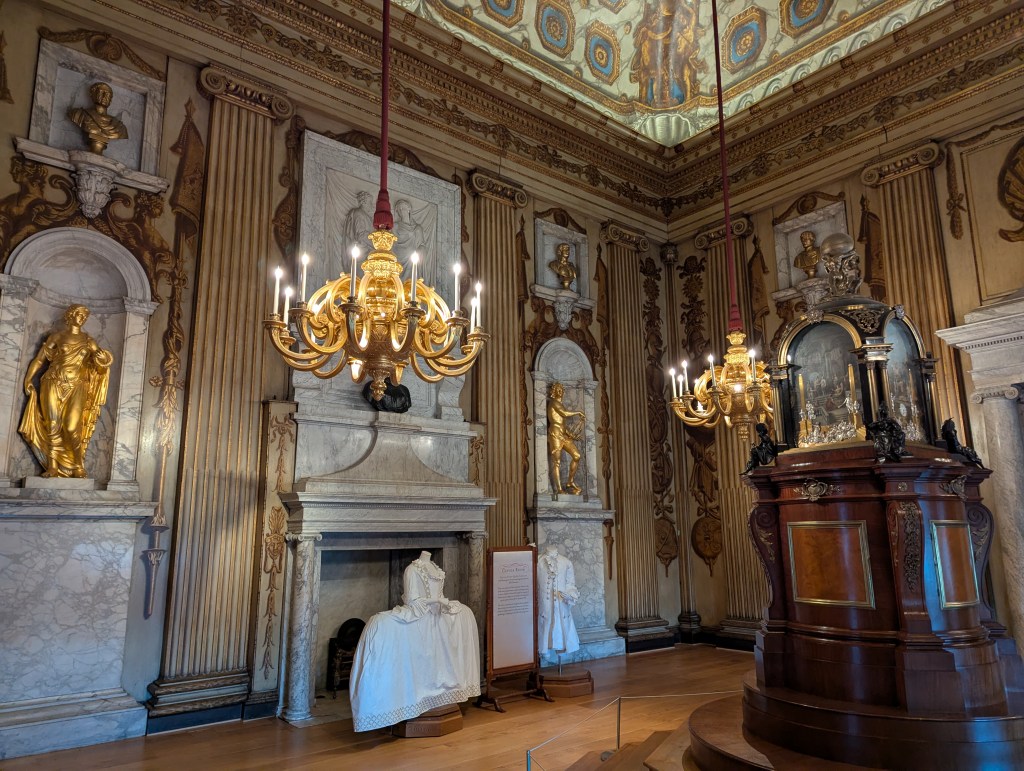
After leaving the Queen’s State Apartments, I next toured the King’s State Apartments, which appear as they would have during the reign of George II (r. 1727-1760). These rooms had a much more public function than the Queen’s State Apartments, as these were the spaces Georgian courtiers would come to in hopes of gaining an audience with the king. The farther you were able to travel through the series of interconnected rooms, the better your odds of seeing the king (and, thus, the higher your social status and importance). The first room I entered was actually the throne room, but the audio guide informed me that the throne was almost always empty. The king did not receive visitors in that room, but courtiers were still expected to bow or curtsy to the empty throne. The most impressive part of the King’s State Apartments – and, perhaps, the entire palace – was the King’s Staircase, which 18th century courtiers (and 21st century tourists) used to access the King’s State Apartments. On the wall opposite the staircase, a painting depicts an imagined scene of courtiers standing along a balcony, looking down at the people ascending the staircase. As the audio guide remarked, this painting depicts a key characteristic of the Georgian court: one came to see and to be seen by others.
The final section of the palace open to visitors is entitled Victoria: A Royal Childhood. In the rooms where Queen Victoria grew up, visitors can learn about her childhood, her education, and the strict “Kensington System” devised by her mother, the Duchess of Kent, and her mother’s advisor, Sir John Conroy. Ostensibly put in place to protect Victoria, who by the age of 11 had become the heir to the British throne, the Kensington System was likely also the Duchess’ and Conroy’s attempt to control Victoria, in hopes of maintaining or furthering their power once she became queen. As part of the Kensington System, Victoria was not allowed to walk down stairs by herself, and her mother slept in the same room as her. Perhaps unsurprisingly, when Victoria became queen in 1837 at the age of eighteen, she quickly dismissed Conroy, moved her mother’s bed out of her room, and left Kensington Palace entirely for Buckingham Palace, which henceforth would be the main residence of the monarch in London. Perhaps reflecting the strict Kensington System or the fact that these rooms were the residence of a young princess, not a queen, Victoria’s childhood rooms at Kensington Palace are not very elaborate (for a palace). Patterned carpets and wallpapers are the main decorative feature, rather than the elaborate painted ceilings of the King’s State Apartments.
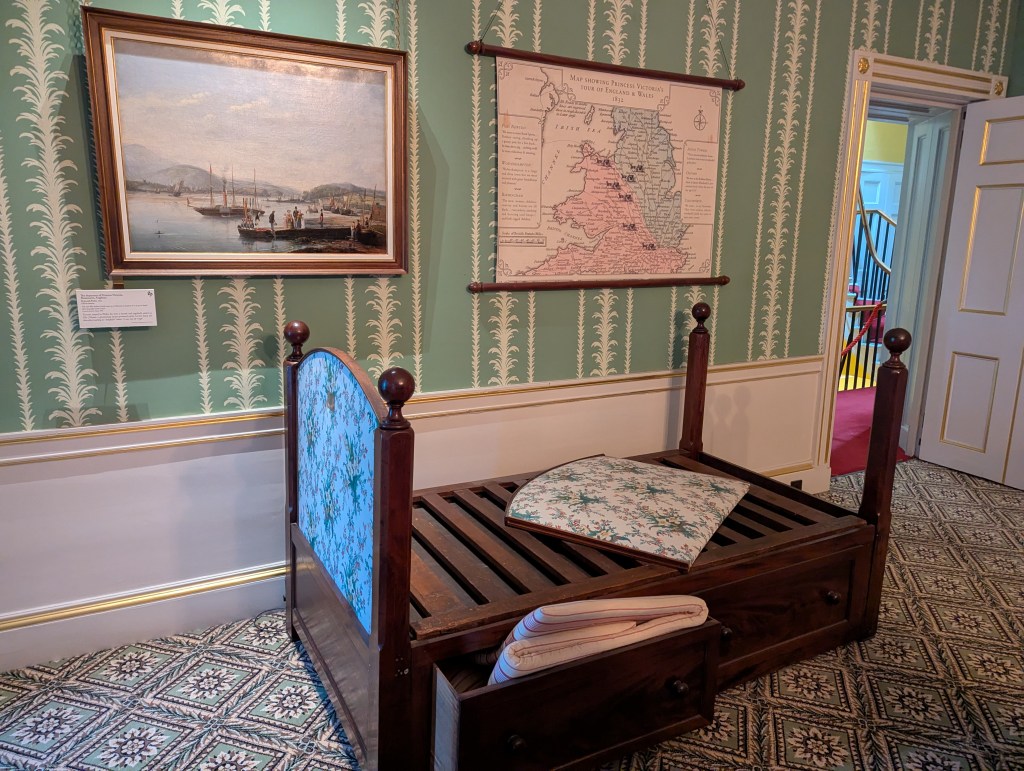
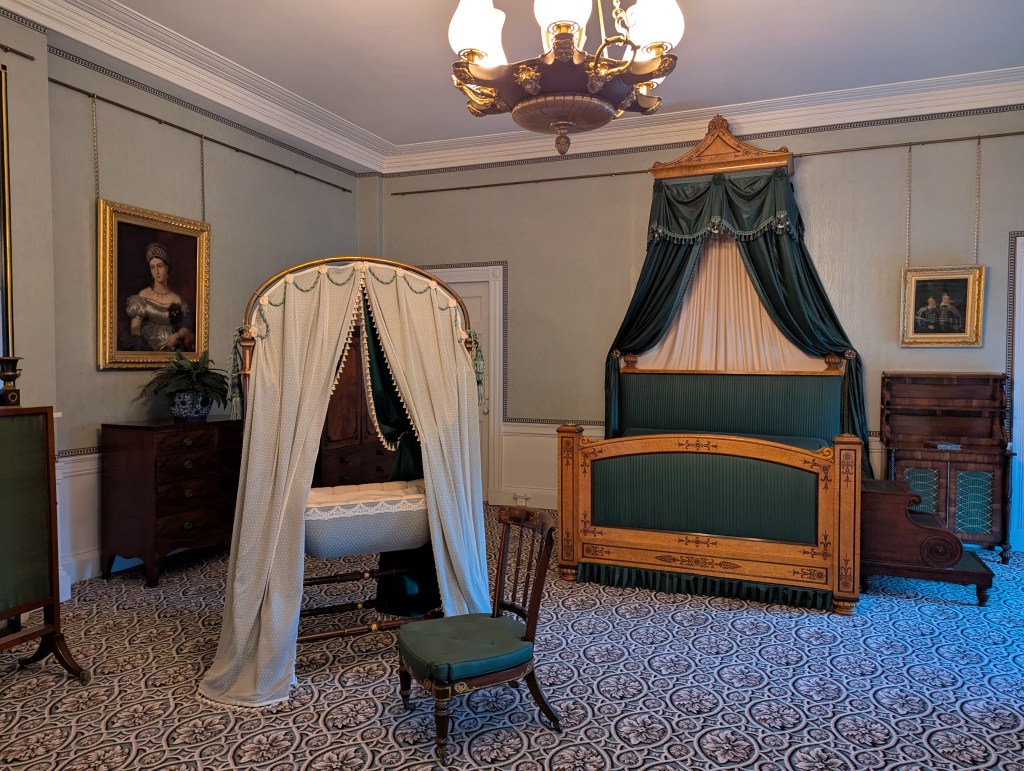
As befitting the season, Victoria’s childhood rooms were decorated for Christmas when I visited. In the final room, a long display showed the types of Christmas presents that Victoria might have received for her final Christmas at Kensington Palace in 1836. Also on display in this room (visible in the background of the picture below) is the dress Victoria wore when she was proclaimed queen after the death of her uncle, King William IV in 1837. Although the dress today appears brown, it would have been black at the time, dyed to reflect Victoria’s mourning the deceased king. Over time, the dye has faded to brown.

Overall, visiting Kensington Palace was an interesting experience, providing a glimpse into three different eras of royal history and life at the palace.



 Making the Past Present
Leave a comment