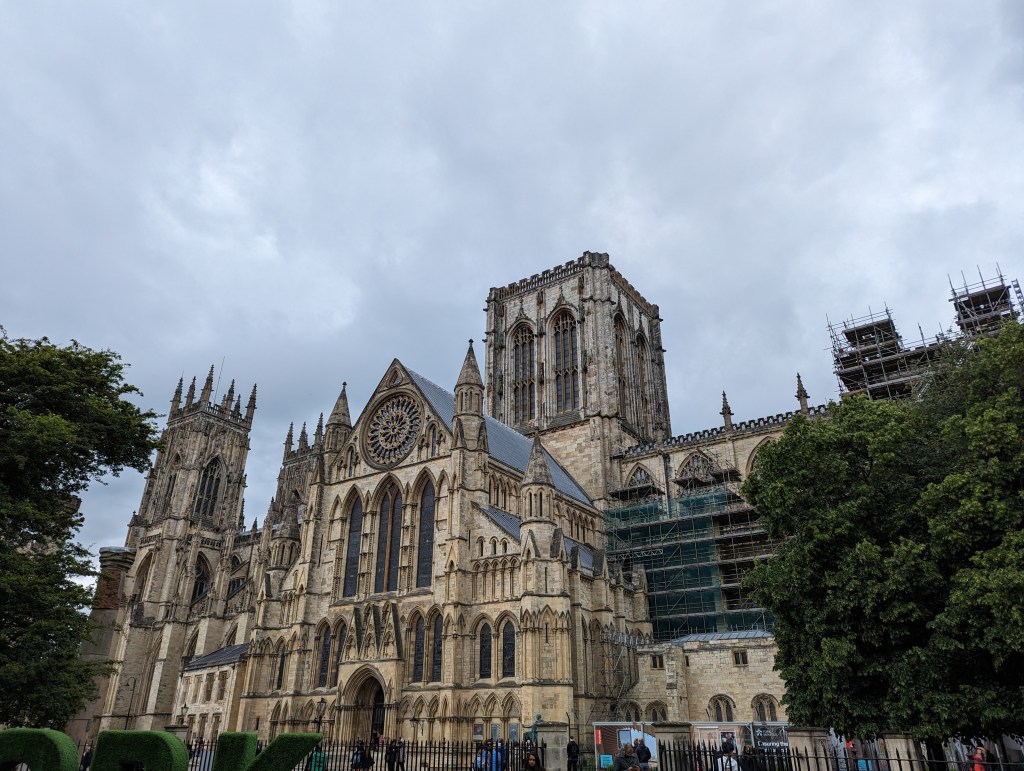
Note: This is the first of a series of posts on the history of York, England, a city that holds a special place in my heart. I lived in York for around six months, and I’ve visited several times since then to do research for my dissertation. The history of York is fascinating, and I love uncovering new aspects of the city’s past whenever I visit.
In northern England, you will find the wonderfully-preserved city of York. Located at the confluence of the rivers Ouse and Foss, York is one of the oldest and most historic cities in England, with connections to every major period of English history from the Roman conquest of Britain to the present. If you want to study English history in a microcosm, look no further than York.
Over the centuries, York has had many names. The Romans called their fortress Eboracum, a Latinization of the ancient Britons’ name for the area, which meant “place of yew trees.” When the Anglo-Saxons settled York several centuries after the Romans left, they named their town Eoforwic. A few hundred years later, the Vikings renamed the town Jorvik after conquering it. In the medieval period, the city’s name gradually evolved from Jorvik (or Everwic in Norman French) to York – and that name has stuck ever since.
With every exploration of the past, one question that must be answered is: “where to begin?” We could start tracing York’s history with the ancient Britons who inhabited the area before the Roman conquest, or even earlier, when the first humans arrived in what is now the United Kingdom. However, because I am a modern historian, not a prehistorian, I have chosen to begin this story of York’s past with the Romans. So, without further ado, let’s raise the curtain of time and step back to 71 CE, when the Roman army arrived at the confluence of the Rivers Ouse and Foss.
Chapter 1: Eboracum
The Roman conquest of Britain (or Britannia, as it was known by the Romans) was already well underway by 71 CE. Julius Caesar had invaded Britain in 55-54 BCE, but he did not establish a lasting Roman presence there. In 40 CE, Caligula assembled an army to invade Britain, but rather than ordering his men to cross the English Channel, Caligula allegedly had them collect seashells as symbols of a victory over the sea. It was not until 43 CE, during the reign of Emperor Claudius, that the Roman invasion of Britain began in earnest.
It took nearly four decades for the Romans to conquer Britain, and, even then, the Romans never conquered the entire island, as the native Britons resisted the Romans’ encroachment upon their territory. In the early decades of the Roman conquest of Britain, British tribes frequently rose up against Roman rule. The most famous of these uprisings was led by Boudicca, a queen of the Iceni tribe, in 60 or 61 CE. Boudicca and her army destroyed several Roman cities, including Camulodunum (Colchester), Londinium (London), and Verulamium (near St. Albans), before being defeated by the Romans. Boudicca died, perhaps by suicide, soon afterwards.
By the early 70s CE, the Roman army had begun to advance north of the Humber estuary, into what is now northern England. This area was ruled by a tribe known as the Brigantes, who had for a time been allied with the Romans. However, around 70 CE, the leader of the Brigantes became increasingly hostile to Roman rule, likely having realized that the Romans intended to conquer his territory. In response, the Roman commander in Britannia sent the Ninth Legion north of the Humber to “subdue” (that is, conquer) the Brigantes and take full control of the area.
After conquering the Brigantes, the Romans constructed a series of military fortresses in northern Britannia. In 71 CE, they constructed a fortress on high flat ground above the River Ouse, near its junction with the River Foss. The area was highly strategic, with good natural defenses and access to the North Sea via the River Ouse and the Humber. The Romans named their new fortress Eboracum, after the Britons’ name for the area, which meant “place of yew trees.” The city we know as York today had been founded.
Over time, Eboracum became an important settlement in Roman Britain. On one side of the River Ouse stood the fortress, housing the Roman legion stationed at York to maintain control of northern Britain and the border area. On the other side of the River Ouse was the colonia, the civilian settlement, where tradespeople and others connected with the Roman army lived. Eboracum’s importance as a frontier settlement and military fortress is indicated by the fact that in the 3rd century CE, Roman officials designated Eboracum as the capital of the new province of Britannia Inferior (northern Britain).


Over the nearly four centuries of Roman rule in Britain, at least three Roman emperors visited Eboracum. There is evidence that Emperor Hadrian stopped in Eboracum in 122 CE on his way north to plan the construction of what became Hadrian’s Wall, the border between Roman Britain and the unconquered regions of the north (today Scotland). In 208 CE, Emperor Septimius Severus visited Eboracum, and the town became Severus’s base for military campaigns against Caledonia (modern Scotland). Severus died in Eboracum in 211 CE. Emperor Constantius Chlorus visited Eboracum in 306 CE while campaigning against the Picts in Scotland. That year, he, too, died in Eboracum. Following the death of Constantius Chlorus, the Roman legion in Eboracum immediately proclaimed his son Constantine as his successor. Emperor Constantine later became famous for legalizing Christianity in the Roman Empire and founding the city of Constantinople (today Istanbul).

While the Roman Empire was at its peak, Eboracum prospered. However, by the early 5th century CE, the Roman Empire was in trouble, having become increasingly unstable due to political turmoil, revolts in various parts of the Empire, and a succession of short-lived emperors. From this period onwards, the Empire became increasingly divided between east and west, with different emperors ruling each part of the empire. Throughout the early 5th century CE, the Western Roman Empire faced repeated invasions by Goths and other Germanic peoples. Struggling to maintain control of its far-flung territories and with the empire’s heartland under threat, Rome withdrew its forces from Britain in 410 CE.
The Roman withdrawal from Britain could not solve the larger problems affecting the empire. In 476 CE, the Western Roman Empire collapsed following the deposition of its final emperor by the Germanic leader Odoacer. However, while the Western Roman Empire collapsed, the Eastern Roman Empire survived. Better known as the Byzantine Empire, it would survive another thousand years, although it gradually lost territory, until the fall of Constantinople to the Ottomans in 1453.
What happened to Eboracum after the Romans withdrew from Britain in 410 CE? No one really knows. For around two hundred years, Eboracum completely disappears from the written historical record. Some historians speculate that the area was abandoned entirely once the Romans left, while others argue that some people continued to live in the area, though perhaps in a smaller settlement than before. It is not until the 7th century that Eboracum reappears in the historical record, now occupied by a new group of people. Find out more in Chapter 2: Eorfowic!



 Making the Past Present
Leave a comment