
After seeing several posts on my Twitter feed today relating to the wedding anniversary of Prince William and Kate Middleton (married twelve years ago today), I found myself thinking about royal weddings. Today, the media often portrays a royal wedding (and the marriage that follows) as a modern-day fairy tale: the beautiful dress, the lavish ceremony, the aristocratic guests, and so on. While the reality behind the scenes might be quite different, the image we are sold is one of glamor, luxury, and, of course, love. As a historian, I feel compelled to point out that this image is very much a product of the twentieth century. Once you start looking back at history, it quickly becomes clear that many royal marriages in British history did not have a fairy tale ending. I’ve gathered some examples below.
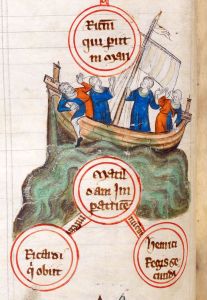
Marriage #1: Henry I and Adeliza of Louvain. Henry married Adeliza of Louvain in 1121, one year after the White Ship disaster, in which Henry’s only legitimate son died (the White Ship sank near the coast of Normandy at the beginning of a voyage to England, carrying many nobles in addition to Henry’s heir). In order to secure the line of succession, Henry decided to marry again – his first wife had died in 1118 – and, hopefully, father another son. His chosen bride, Adeliza of Louvain, was thirty-five years younger than him. One can only imagine what the eighteen-year-old Adeliza thought when she married fifty-four-year-old Henry. Adeliza and Henry had no children together, causing Henry to leave the throne to his daughter Matilda, which set off a long period of civil war between her and her cousin (Henry’s nephew) Stephen of Blois, who usurped the throne from her when Henry died in 1135. After Henry’s death, Adeliza married again and had seven children with her second husband; she died in 1151.
Marriage #2: King John and Isabella of Angoulême. This is another – though far from the last – instance of a king marrying a woman much younger than him. When King John married Isabella of Angoulême in 1200, she was only 12 or 14, while he was twenty years her senior. If that wasn’t enough, John divorced his first wife, Isabella of Gloucester, in order to marry Isabella of Angoulême. Contemporary sources suggest that John was infatuated with Isabella of Angoulême, who was said to be quite beautiful. However, another attraction was her land holdings, which were strategically connected to his own domains in France. Beyond the fact that he was already married, John’s decision to marry Isabella created problems, because Isabella was already engaged to a French count. After marrying Isabella, John had to crush an uprising in his French domains led by her former fiancé, who was angry over not receiving any compensation for the broken engagement. John and Isabella had five children together; after his death in 1216, she married the son of her former fiancé and had nine more children. She died in 1246.
Marriage #3: Richard II and Isabella of Valois. Richard II’s marriage to Isabella of Valois is a prime example of the strategic calculation at the heart of many royal marriages. Richard’s first wife, Anne of Bohemia, died in 1394. They had had no children, so Richard needed an heir to the throne in order to ensure the succession, especially since there were many other potential claimants to the throne, thanks to the many descendants of Edward III. At this time, England was also in the middle of the Hundred Years’ War with France, which factored into many of Richard’s decisions. In 1396, Richard and Charles VI, the king of France, agreed on a truce. One part of the deal was that Richard would marry Charles’s daughter, Isabella of Valois. This was not uncommon at the time, but what was unusual was that Isabella was only six at the time, while Richard was twenty-nine years old. According to the custom of the time, it was agreed that the marriage would not be consummated until Isabella was twelve years old. Before that could happen, however, Richard was overthrown by his cousin Henry of Bolingbroke (who became Henry IV) and died in captivity in 1400. Isabella, a widow at the age of ten, married a cousin in 1406, but tragically died three years later in childbirth at the age of nineteen.

Marriage #4: Edward IV and Elizabeth Woodville. When Edward IV married Elizabeth Woodville in 1464, it was the first time a king had married a commoner since the Norman Conquest in 1066. Their marriage took place in the context of the Wars of the Roses, a decades-long civil war between the House of York and the House of Lancaster, rival branches of the Plantagenet dynasty, both of whom claimed the throne. This is important, because Edward IV was a Yorkist. Elizabeth Woodville’s first husband, however, had been killed fighting for the Lancastrians. In addition to Elizabeth’s social status, this fact proved difficult to swallow for many of Edward’s nobles, especially Richard Neville, Earl of Warwick, who had been negotiating with France in the hopes that Edward would marry a French princess. When Edward married Elizabeth, his relationship with Warwick was never the same, which became significant in the Wars of the Roses, as Warwick (nicknamed “the Kingmaker” because of his power) would go on to restore Henry VI (a Lancastrian) to the throne in 1471. If the marriage created so many problems, why did Edward marry Elizabeth? Was it a love match? Probably not. Edward was not known for his fidelity – he had numerous mistresses before and after his marriage – and most historians agree that he married Elizabeth on impulse. Following Edward’s death in 1483, Elizabeth’s children were declared illegitimate by Edward’s brother Richard, who seized the throne, becoming Richard III. Her young sons Edward and Richard were sent to the Tower of London, never to be seen again, and her brother and son from her first marriage were executed. Elizabeth survived Richard III’s reign, and regained her status when Henry VII, the first Tudor king, married her daughter Elizabeth of York in 1486. Elizabeth Woodville died in 1492.
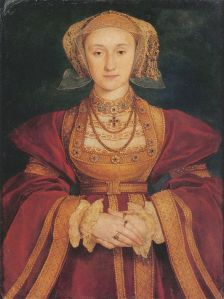
Marriage #5: Henry VIII and his six wives. This is probably the least surprising entry on this list. Thanks to the popularity of books, films, TV shows, and musicals about the Tudor king and his many wives, the details of Henry VIII’s marriages are well-known – and none of them was a fairy tale. After divorcing his first wife, Catherine of Aragon, to marry Anne Boleyn in hopes of gaining a male heir, Henry moved from wife to wife for the rest of his life, proving himself willing to discard his current wife when he lost interest in her or when she did not give birth to a son, in the case of Catherine of Aragon and Anne Boleyn. Henry’s fourth marriage, to Anne of Cleves, lasted only six months. Henry had his marriage to Anne annulled when he was less-than-impressed with her appearance; he found her less attractive than her portrait, painted by the famous painter Hans Holbein. Henry had his next wife, Catherine Howard, executed for adultery; as soon as Henry was informed of Catherine’s alleged adultery, he turned his back on her completely and never saw her again, though her execution was several months later. Catherine Parr (viewed as the “survivor” because she outlived Henry) almost suffered a similar fate. She narrowly avoided arrest, but managed to persuade Henry that she had argued with him about religion in order to take his mind off his pain caused by an ulcerous leg; they reconciled and remained married until his death in 1547. Only two of Henry’s wives survived him: Catherine Parr, who married again and died in childbirth in 1548, and Anne of Cleves, who never married again and died in 1557.
Marriage #6: Charles II and Catherine of Braganza. Charles II married Catherine of Braganza in 1662. The marriage was designed to cement an alliance between England and Portugal against their common enemy Spain; as part of Catherine’s dowry, Charles received territory in India, which had a significant influence on the development of British rule in India. As a Catholic, Catherine was unpopular in largely-Protestant England. Furthermore, she had a difficult position at court, as she never had any children (her pregnancies all ended in miscarriage). While Catherine remained faithful to Charles, Charles was certainly not faithful to her. He had many mistresses and acknowledged twelve illegitimate children. Charles was also not discreet in his affairs; he forced Catherine to accept one of his mistresses, Barbara Palmer, Duchess of Cleveland, as one of her Ladies of the Bedchamber. In response, Catherine sought to return to Portugal, but Charles compelled her to remain in England. After Charles’s death in 1685, Catherine remained in England for several more years, but she eventually returned to Portugal in 1692 and died there in 1705.
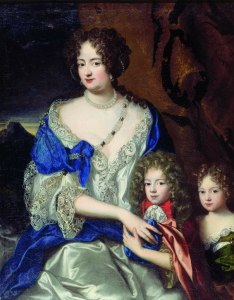
Marriage #7: George I and Sophia Dorothea of Celle. George and Sophia Dorothea married in 1682, long before George, a German prince, knew that he would become the heir to the British throne. (Because the Bill of Rights of 1689 barred Catholics from the throne, the nearest Protestant heir to the childless Queen Anne was Sophia of Hanover, a descendant of James I; she predeceased Anne, leaving her son George to inherit her claim to the British throne.) George and Sophia Dorothea’s marriage was not a success, as George and his mother both viewed Sophia Dorothea as inferior in status and manners. After the birth of two children, the couple became estranged, as George preferred to spend his time with his mistress, Melusine von der Schulenburg. Around 1690, Sophia Dorothea was reunited with Philip Christoph von Königsmarck, a Swedish count she had met in childhood. The two became closer, and by 1694 rumors that they were having an affair were rampant at the Hanoverian court. In July 1694, Königsmarck disappeared without a trace, probably killed on the orders of George or his father. In December 1694, George divorced Sophia Dorothea, not for adultery, which she always denied, but on the grounds of desertion. After the divorce, Sophia Dorothea was forbidden to remarry or see her children again, and she was imprisoned in a castle for the rest of her life (on George’s orders and with the agreement of her father). She never saw her former husband, her children, or her father again, although her mother visited her until her death in 1722. Sophia Dorothea died in 1726. For his part, George never remarried; he had three children with his mistress Melusine von der Schulenburg, who accompanied him to England when he became King of Great Britain in 1714 (and he probably had other mistresses as well).
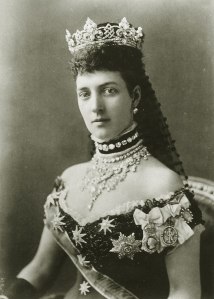
Marriage #8: Edward VII and Alexandra of Denmark. Edward married Alexandra in 1863 while he was Prince of Wales; he was 21, she was 18. Throughout their marriage, Alexandra remained faithful to Edward, as was expected of a woman in her position, while Edward had many mistresses. Alexandra was aware of Edward’s many extramarital relationships; she even allowed one of his long-time mistresses, Alice Keppel, visit him on his deathbed. While Edward was busy socializing (and more) with his various mistresses, Alexandra preferred to spend time at home with their children, particularly after several bouts of ill health. She was seriously ill with rheumatic fever in 1867, which left her with a permanent limp. Edward, apparently, showed little concern during Alexandra’s serious illness, something which he was criticized for. As Princess of Wales and later Queen, Alexandra undertook a number of public duties and was generally well-liked by the public; however, she was largely excluded from having any influence on politics. Alexandra suffered several personal tragedies later in life, including the death of her eldest son, Albert Victor, in 1892, and the execution of her nephew Tsar Nicholas II and his family in 1918. After Edward’s death in 1910, Alexandra continued her charitable work; she died in 1925.
There you have it: marrying into a royal family has, throughout history, not been a fairy tale for many women, who often had little choice in who they married and, once married, were expected to adhere to codes of behavior that their royal husbands frequently broke. Pressure to secure the line of succession led to middle-aged kings taking young brides – or broke up royal marriages altogether. For royal women who dared to step outside of the box, the consequences could be severe. Even today, although royal wives no longer face the threat of being imprisoned for life in a castle, they face constant scrutiny by the media, who constantly judge them on their appearance and actions. To all of that, I say: I’d much rather remain a commoner.







 Making the Past Present
Leave a reply to The Chronicles of History Cancel reply