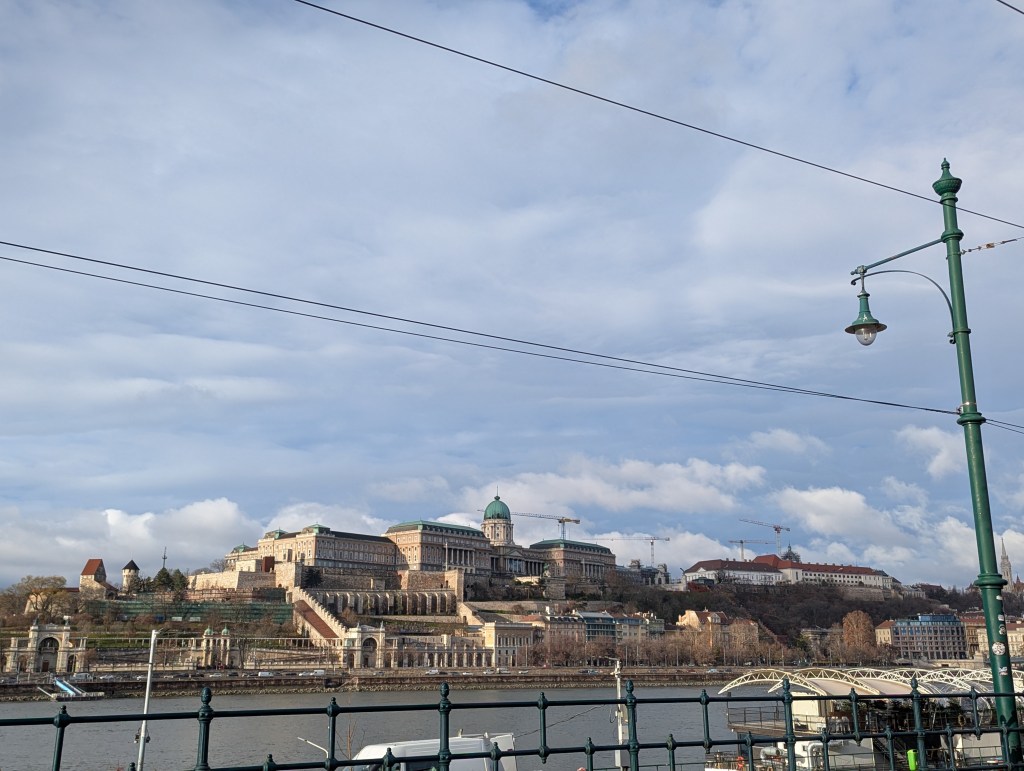
Although I’ve taught the history of Central Europe within my European history survey courses, I haven’t traveled nearly as much in Central Europe as I have in Western Europe. I’ve visited Austria a number of times, I traveled to Slovenia once, and I went to Poland for the first time this summer, but other than that, I haven’t explored this fascinating region, until recently, that is. I recently went to Budapest (and, by extension, Hungary) for the first time. While in Budapest, I went to a number of very interesting historic sites, so rather than focus this post on one part of my Budapest trip, I’m going to provide an overview of the different places I went.
On my first night in Budapest, I explored the Christmas market in the square in front of St. Stephen’s Basilica, on the Pest side of the city. Budapest began as two separate cities – Buda and Pest – on either side of the Danube. It wasn’t until the 1840s that a bridge connected Buda and Pest for the first time, creating the city of Budapest. Today, people still refer to the Pest side or the Buda side of the city.

For almost three hundred years, Hungary was part of the Austrian Empire (after 1867, the Austro-Hungarian Empire). As an example of the cultural influence of Austrian rule, I noticed several similarities between the Christmas market in Budapest and Christmas markets in Austria and Germany. Some of the food being sold at the Budapest Christmas market was Hungarian specialties, but vendors also were selling chimney cakes (similar to the German Baumstriezel) and mulled wine (aka Glühwein).
On my first full day in Budapest, I visited the Dohány Street Synagogue, which is the largest synagogue in Europe, seating 3,000 people. The synagogue was built between 1854 and 1859, and the architecture has distinct Moorish influences. I learned from the guide that several of the architectural features of this synagogue are unusual, as the synagogue was constructed in a time when some Hungarian Jews sought to demonstrate their assimilation.
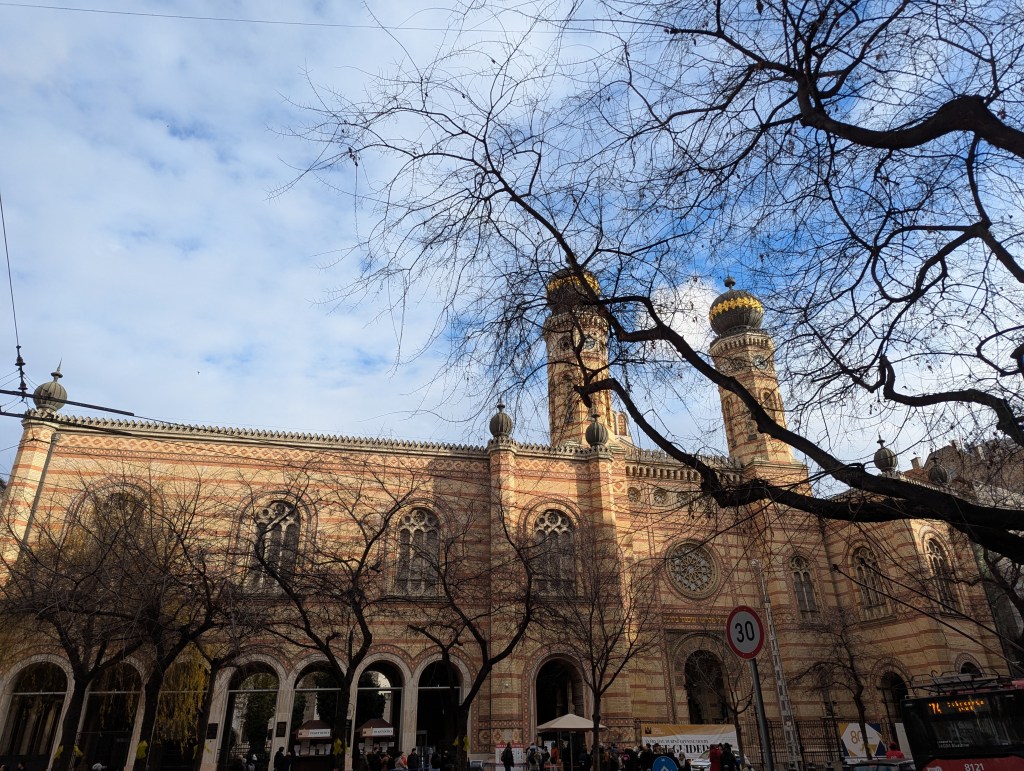
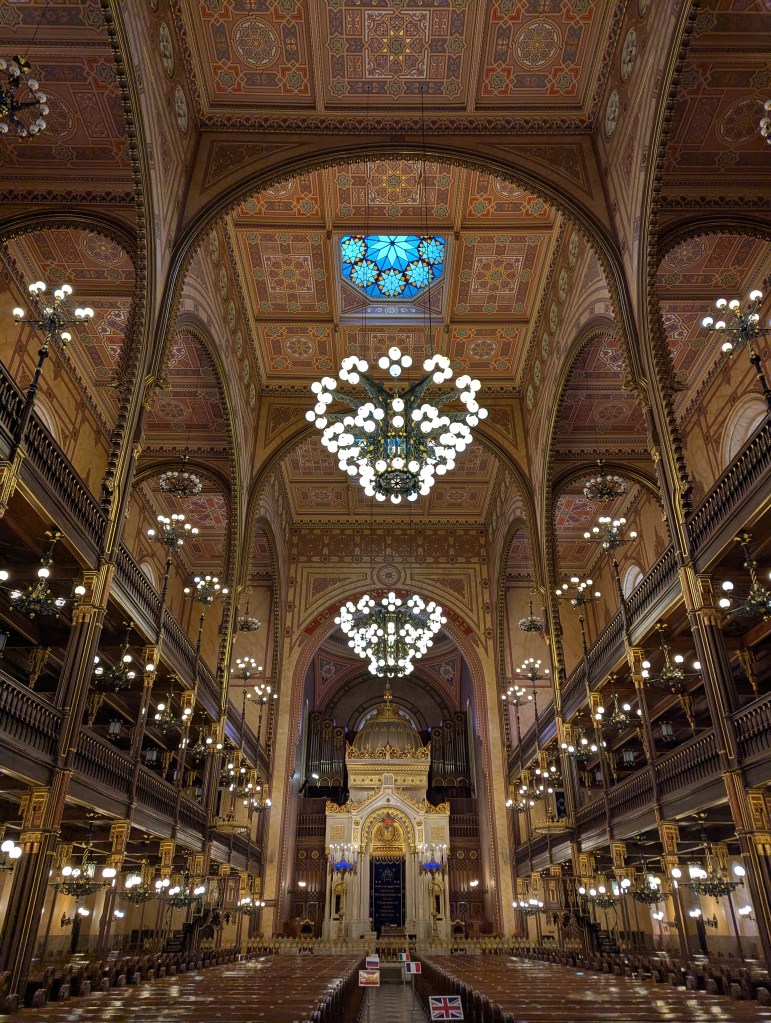
The shape of the synagogue is long and rectangular, more akin to a cathedral than the traditional shape of a synagogue. Additionally, the bimah – the podium where the Torah scrolls are placed – is at one end of the synagogue, rather than in the center. The placement of the bimah in the Dohány Street Synagogue evokes an altar in a Christian church. Finally, while the stained glass windows have stars in them, the stars are not the traditional shape of the Star of David.

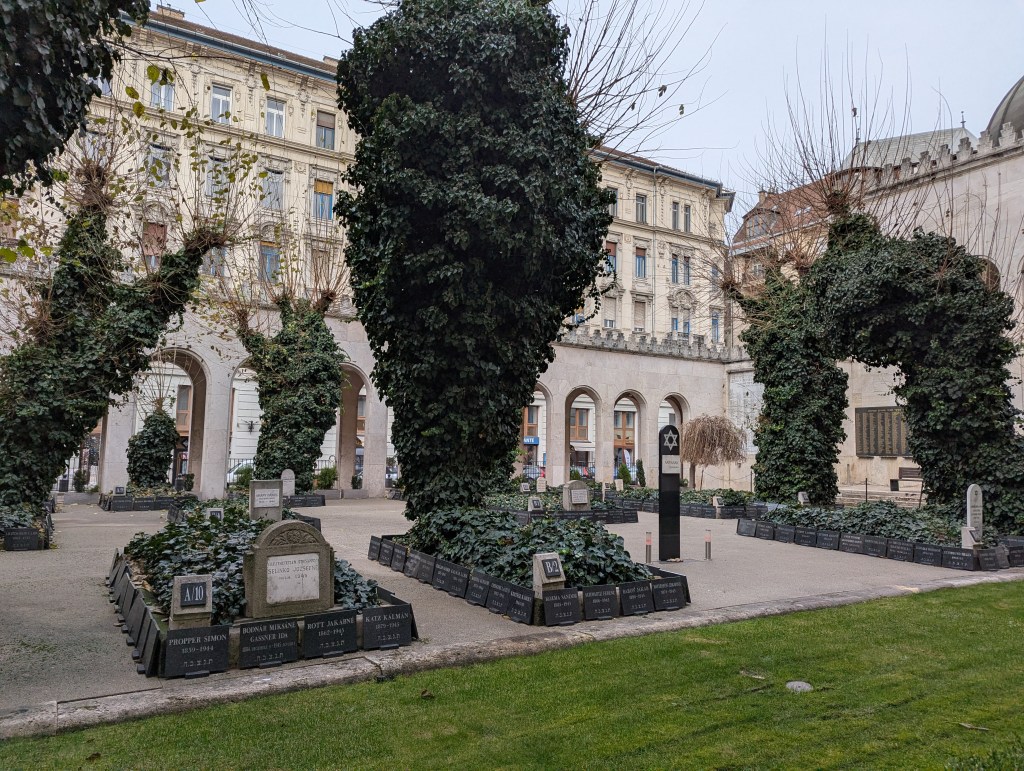
Another unusual feature of the synagogue is that there is a cemetery on the grounds outside. Traditionally, Jewish cemeteries are not built adjacent to synagogues, to keep separation between a place of life (the synagogue) and a place of death (the cemetery). In the case of the Dohány Street Synagogue, the cemetery is a series of mass graves where around 3,000 people who died in the Budapest Ghetto in late 1944 and early 1945 are buried. The victims of the ghetto were buried there soon after the Siege of Budapest ended in 1945 and have never been disinterred, as that would violate Jewish religious practice. Today, the mass graves are ringed by tombstones with the names of the dead – at least for those that are known, as not all of the bodies could be identified.
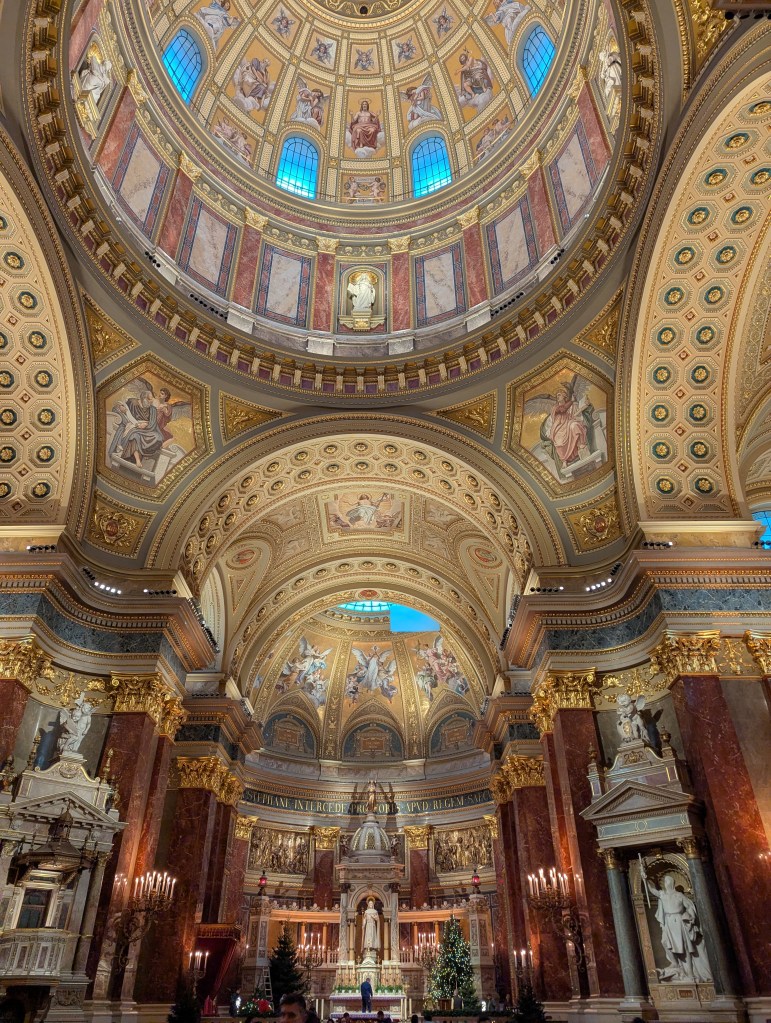
After touring the Dohány Street Synagogue, I also visited St. Stephen’s Basilica, a large Catholic church on the Pest side of the city. The church is named for St. Stephen, who became the first king of Hungary in 1000 and is an important saint in Hungary. St. Stephen’s Basilica was constructed from 1851 to 1905. The interior is extremely ornate, with gold, richly colored marble, mosaics, and more.


From St. Stephen’s Basilica, I headed toward the Danube, where I saw the Hungarian Parliament building and then walked down the river a short ways to the Shoes on the Danube Bank memorial. Constructed in 2005, this memorial honors Hungarian Jews who were murdered by militia connected with the Arrow Cross party (the Hungarian fascist party) in late 1944 and early 1945. The Arrow Cross murdered as many as 20,000 Jews from the Budapest Ghetto on the banks of the Danube. Victims were ordered to remove their shoes before they were shot. The memorial comprises a series of iron shoes along the bank of Danube, as if they had just been removed by Jews before their deaths. As is the case of many modern Holocaust memorials, the Shoes on the Danube Bank memorial is a memorial of absence, making you think about what happened to the people who had been wearing the shoes.


After a somber end to the day at the Shoes on the Danube Bank memorial, it was time for some hearty Hungarian food for dinner. I sampled two Hungarian specialties: goulash soup and beef stew, both of which were quite tasty.

Up to this point, I had only been on the Pest side of the city. I didn’t make it across the river to Buda until my second (and last) full day in Budapest. To read more about that, stay tuned for part two of my highlights of Budapest.




 Making the Past Present
Leave a reply to Herald Staff Cancel reply